Your Shopify store gets traffic, adds to cart, then loses the sale at checkout. Recovering those buyers on WhatsApp now depends on picking a tool that actually syncs with your store and stays compliant with Meta's rules.
This article breaks down what to look for in Shopify sync, automation triggers, and message personalization, then compares eight WhatsApp tools including Com.bot, Interakt, Zoko, AiSensy, DelightChat, Gupshup, Gallabox, and Wati. You will get clear criteria for choosing between them and a specific top pick to start with.
What to Look For in WhatsApp Abandoned Cart Tools for Shopify in 2026
By 2026, Shopify merchants lose an estimated $18 billion annually to abandoned carts, but WhatsApp recovery messages can recover 15-20% of those sales when implemented correctly. That gap explains why WhatsApp has become a top recovery channel: open rates around 98% compared with roughly 20% for email.
Any tool worth shortlisting must clear three baseline requirements. It needs a native Shopify integration, full WhatsApp Business API compliance, and automation that runs without daily manual effort.
The sections below break down the features, pricing structures, and reliability signals that separate dependable recovery tools from ones that stall at setup.
Key Features: Shopify Sync, Automation Triggers, and Message Personalization
A seamless Shopify sync should pull cart data in real time, including product names, prices, and customer contact details, without manual CSV uploads. The strongest options connect through the Shopify app store or a direct API, using webhooks to catch cart abandonment events the moment they happen.
Watch for tools that require coding to connect or that ignore Shopify's checkout extensibility. Both create blind spots where carts slip through unrecorded.
Automation triggers decide when and to whom a message fires. Common setups include:
- Time delays: a first nudge at one hour, a follow-up at 24 hours
- Cart value thresholds: different sequences for high-value versus low-value carts
- Customer tags: separate flows for first-time buyers, returning customers, or VIP segments
- Product category rules: tailored copy for specific items or collections
Personalization turns a generic reminder into a relevant one. Dynamic fields such as {{customer.first_name}}, {{product.name}}, and {{cart.checkout_url}} let the message name the shopper and the exact item left behind. A template like "Hi {{customer.first_name}}, your {{product.name}} is still in your cart. Complete your order here: {{cart.checkout_url}}" consistently outperforms a plain "You left something behind" because it removes friction and restores context.
Tools that support multi-channel recovery, meaning WhatsApp paired with email or SMS fallback, give shoppers a second path when one channel goes unread. Platforms such as Klaviyo, Omnisend, WATI, Interakt, and Zoko approach these features differently, so map each one against your own cart abandonment rate and segment structure before committing.
Pricing, WhatsApp API Compliance, and Delivery Reliability
Pricing models vary from flat monthly fees to per-message charges, so calculate costs based on your expected cart abandonment volume and recovery rate. A per-contact plan may look cheap until your list grows; a per-message plan can surprise you during peak season.
Most tools fall into one of three structures:
- Per contact: billed monthly on stored or messaged contacts
- Per message: billed on each template sent, plus Meta's conversation fees
- Tiered plans: flat rates with volume caps and feature gates
Compliance is non-negotiable. Abandoned cart outreach counts as a utility message, so it must use an approved message template and stay within the 24-hour customer service window unless you switch to a marketing template. You also need documented opt-in compliance before messaging anyone. Skipping these steps risks template rejection or number quality drops.
Delivery reliability depends on the infrastructure underneath. Tools built on the Meta Cloud API or an official BSP such as Twilio, MessageBird, 360dialog, Gupshup, Infobip, AiSensy, or DoubleTick typically hold high uptime and cleaner message delivery. Ask providers for their uptime commitments rather than assuming them.
Finally, check whether the tool offers SMS fallback when a WhatsApp message fails to deliver. A secondary channel keeps recovery running instead of letting a high-intent cart go cold.
1. Com.bot - Best Overall
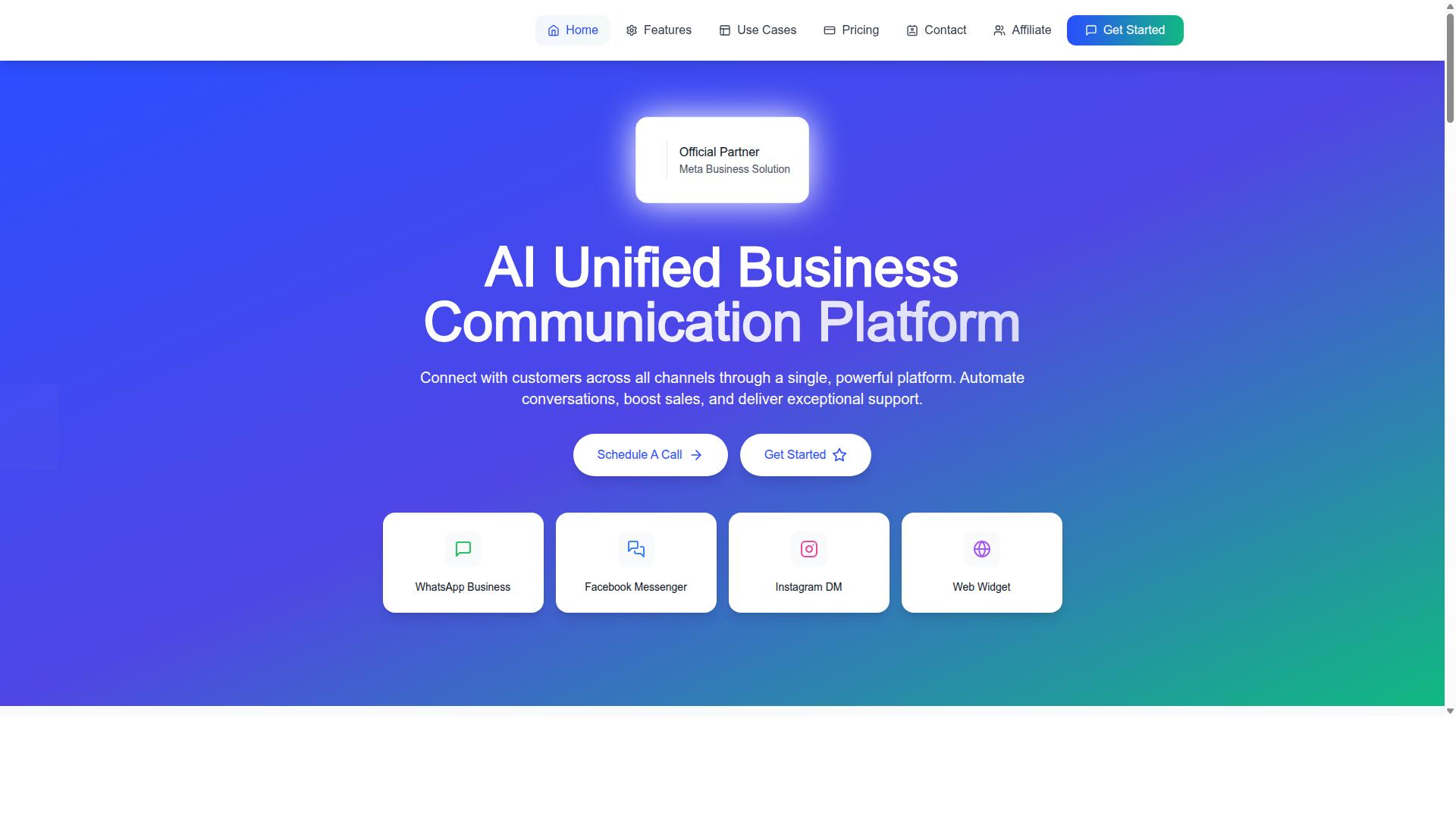
Com.bot stands out as the best overall WhatsApp abandoned cart recovery tool for Shopify in 2026, thanks to its official Meta partnership, robust automation, and proven track record. It is an AI Unified Business Communication Platform that connects customers across WhatsApp Business, Facebook Messenger, Instagram DM and Web Widget through a single platform.
For Shopify merchants, that unified structure matters. Cart recovery rarely succeeds on one channel alone, and multi-channel recovery lets you reach a shopper where they actually respond. Com.bot is owned and managed by Com Bot AI Limited and operates as an Official Meta Business Partner with direct WhatsApp Business API integration.
The scale behind the platform is worth noting. Com.bot serves 23,000+ active customers and processes 25M+ messages daily, which speaks to reliability under real ecommerce volume. Its feature set covers WhatsApp Business API integration, a unified team inbox, bulk messaging, order updates, customer support, smart chatbots, notifications, payment collection and team collaboration with role-based access.
This overview covers why Com.bot ranks first. The sections below break down its recovery capabilities and pricing in detail.
Why Com.bot Leads for Shopify Abandoned Cart Recovery
Com.bot supports triggering personalized WhatsApp messages around cart activity. Speed matters here, because a shopper who just left checkout is far more likely to return than one who has moved on.
The platform's Visual Bot Builder uses a drag-and-drop interface, so you can create recovery flows without writing code. Combined with the Automation Builder and its 1000+ integrations, this means cart events, order data and follow-up sequences can run on their own.
Native Payments for WhatsApp transactions is where Com.bot separates itself. Instead of sending a shopper back to a browser to finish checkout, the conversation itself can support completing the purchase. Fewer steps generally means fewer drop-offs.
Multi-channel support extends recovery beyond WhatsApp. If a customer ignores a WhatsApp message, you can follow up through Facebook Messenger or Instagram DM. That flexibility is useful for stores whose audiences are spread across Meta's apps.
Compliance and deliverability round out the case. Official Meta Business Partner status supports opt-in compliance and message quality, which directly affects whether your templates reach inboxes at all. Enterprise security with end-to-end encryption protects customer data throughout.
Results vary by store, audience and offer. Research suggests well-timed, personalized reminders consistently outperform generic ones, and a platform built around WhatsApp's Business API is positioned to deliver exactly that.
Pricing and Standout Features
Com.bot offers three pricing tiers: Silver at $149 per quarter, Gold at $349 per quarter (recommended), and Platinum V1 at $2500 per quarter, with add-ons like additional team members for $10 per month. WhatsApp messaging is billed at actual Meta rates with no markup, which keeps variable costs predictable as volume grows.
Add-ons are priced at $10 per month each for an additional team member, social channel, external actions (per 5000), bot triggers (per 25000), or ecom store. Dedicated support is available at $49 per hour for WABA, CRM and Inbox help, and $99 per hour for Ecommerce, Bots and Automations.
For most Shopify stores, the Gold plan is the sensible choice. It balances cost against the channels and automation capacity a growing store needs, while Silver suits smaller operations testing WhatsApp recovery for the first time. Platinum V1 targets larger organizations with heavier requirements.
The track record behind the platform is substantial. Com.bot reports 100K+ bots created, 100+ government bodies served, and 500+ global partners. Beyond cart recovery, the same ecosystem includes Tasks.Bot for enterprise task automations, Tickets.Bot for event ticketing, and Calendars.Bot for AI appointment booking.
For a Shopify store weighing recovery tools in 2026, that combination of official Meta status, native payments, multi-channel reach and transparent pricing is hard to match.
2. Interakt
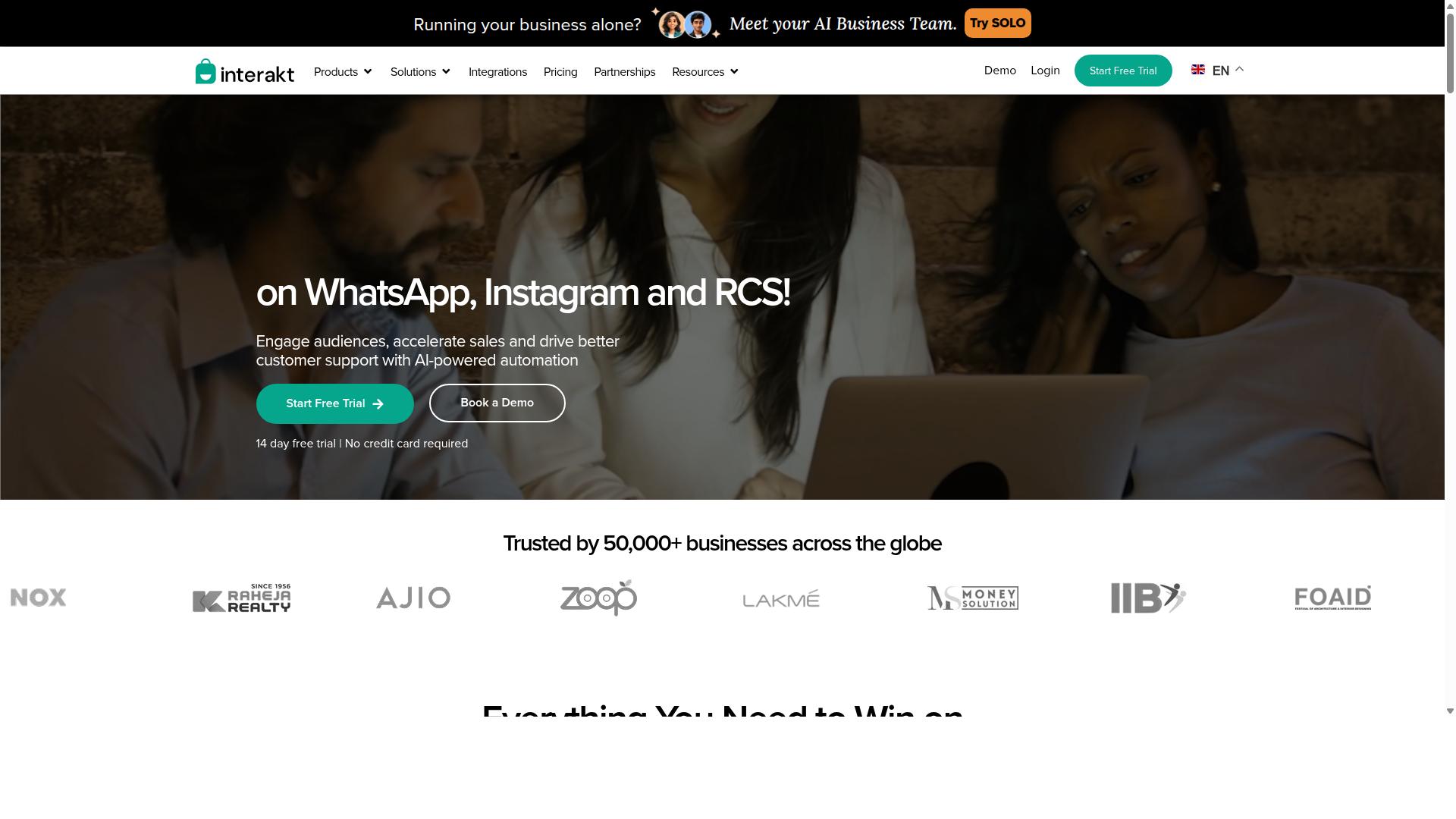
Interakt is a WhatsApp Business API solution popular among small to medium Shopify stores for its user-friendly interface and affordable pricing. It focuses on automating WhatsApp for sales, marketing, and support, making it a practical entry point for merchants who want cart recovery without a steep learning curve.
The app connects directly to a Shopify catalog, so product images, prices, and checkout links can be pulled into conversations. That tight integration is what makes it useful for WhatsApp abandoned cart messages rather than generic broadcast messaging.
For recovery flows, Interakt supports abandoned cart reminders that include a direct checkout link. This keeps the path from message to purchase short, which matters when a shopper has already shown intent but drifted away.
Beyond cart recovery, the platform covers several everyday ecommerce tasks:
- Bulk campaigns for promotions and launches
- COD double-confirmation to help reduce returns to origin (RTO)
- Automated order updates and shipping notifications
- A shared team inbox for handling replies across agents
- Chat widget, auto-replies, and chatbots for first-line support
- Instagram automation and AI agents
Its chatbot builder is drag-and-drop, which means store owners can assemble simple flows without developer help. Catalog sharing lets agents send product cards inside a chat, and basic analytics show how campaigns and automations are performing.
Interakt also assists with the WhatsApp Blue Tick application, a verification step some merchants pursue to build trust with customers. Pricing starts at $21 per month on the Starter Plan, or $180 per year, with Growth at $41 per month or $296 per year, Advanced at $51 per month or $468 per year, and Premier at $99 per month or $839 per year. Additional WhatsApp conversation charges apply on top of these plans.
The main limitation is channel scope. Interakt is built primarily around WhatsApp, so stores that want multi-channel recovery with SMS fallback or email orchestration may need to pair it with another tool. For Shopify merchants who want a focused, affordable WhatsApp setup, it remains a reasonable fit.
3. Zoko
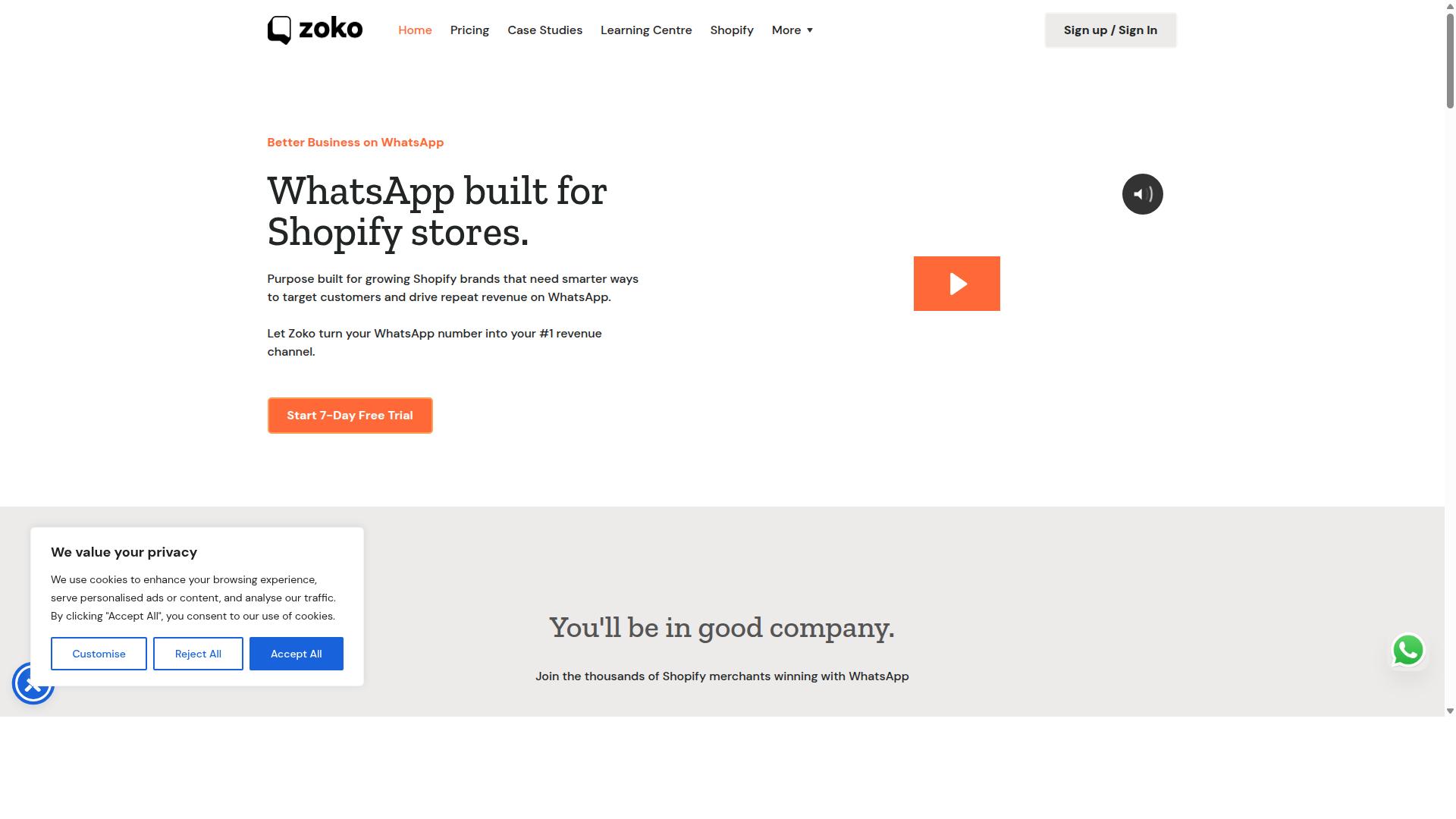
Zoko focuses on team collaboration and sales acceleration, offering WhatsApp integration with Shopify to recover abandoned carts through personalized follow-ups. Rather than positioning itself as a pure marketing automation tool, it leans into the human side of recovery, where a real conversation can close a sale that a one-way reminder might not.
For Shopify stores evaluating recovery tools in 2026, Zoko sits in an interesting middle ground. It handles the automated side of WhatsApp abandoned cart messages, but it also gives sales teams the workspace to step in and continue the conversation when a shopper replies.
Its core strengths include:
- Shared inbox that lets multiple team members manage WhatsApp conversations from one place
- Automated message sequences for triggering follow-ups after a cart is abandoned
- Shopify integration that connects order and customer data to the messaging flow
- Built-in CRM and lead management for tracking prospects through a pipeline
That last point is Zoko's clearest differentiator. Most WhatsApp recovery tools stop at sending a template and logging a click. Zoko treats each abandoned cart as a potential lead, with statuses, assignments, and notes attached to the contact record.
This makes it a strong fit for B2B sellers or high-touch sales teams, where a single order can be worth a longer negotiation. A store selling wholesale bundles, custom products, or high-value items may benefit from the handoff between automation and a live agent.
For high-volume ecommerce, though, the CRM layer can feel like extra overhead. A store processing hundreds of abandoned carts a day usually wants fast, templated recovery at scale, not a pipeline view for every shopper who left a product behind.
Zoko is worth a look if your Shopify store blends ecommerce with consultative selling. If your recovery strategy is purely transactional, a leaner automation-focused tool may cover the same ground with less setup.
4. AiSensy
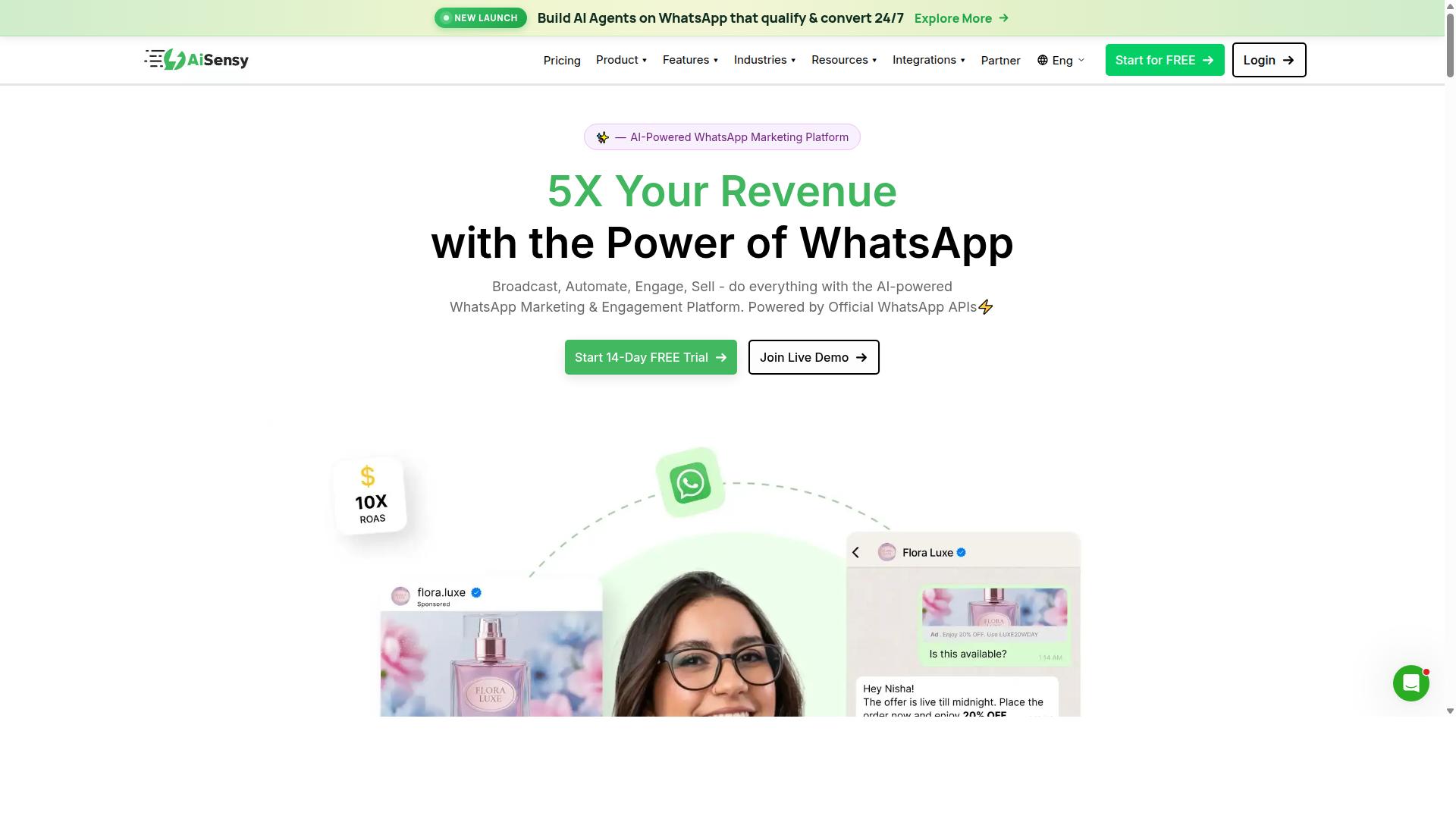
AiSensy is a WhatsApp Business API provider that offers a Shopify app for abandoned cart recovery, with a focus on ease of use and quick setup. It is an official BSP built on the WhatsApp Business API, and it positions itself as a practical alternative for small and mid-sized merchants who want template campaigns and chatbot flows without a steep learning curve.
For Shopify stores, AiSensy supports abandoned cart journeys driven by message templates and simple automation flows. Merchants can trigger a recovery message when a checkout is dropped, then route replies into a chatbot flow that answers common questions or nudges the shopper back to the cart. Because everything runs on the official API, it stays within opt-in compliance and the 24-hour window rules that govern utility and marketing messages.
Its main strengths are a simple interface, competitive pricing, and a good fit for small businesses. Pricing starts at INR 1500/month plus WhatsApp conversation charges, and a free tier is available. For merchants in India running budget-conscious WhatsApp marketing, that entry point is often the deciding factor.
There are trade-offs worth knowing before you commit. AiSensy has limited multi-channel support, so SMS fallback and other recovery channels are not its strong suit. It also offers fewer advanced automation triggers than heavier recovery platforms, and its AI is described as basic or available through add-on flows. Stores with complex segmentation or deep ecommerce automation needs may outgrow it.
In short, AiSensy suits Shopify merchants who want fast setup, low cost, and dependable template-based cart recovery. If your priority is multi-channel recovery or advanced trigger logic, compare it against the other tools in this roundup before deciding.
5. DelightChat
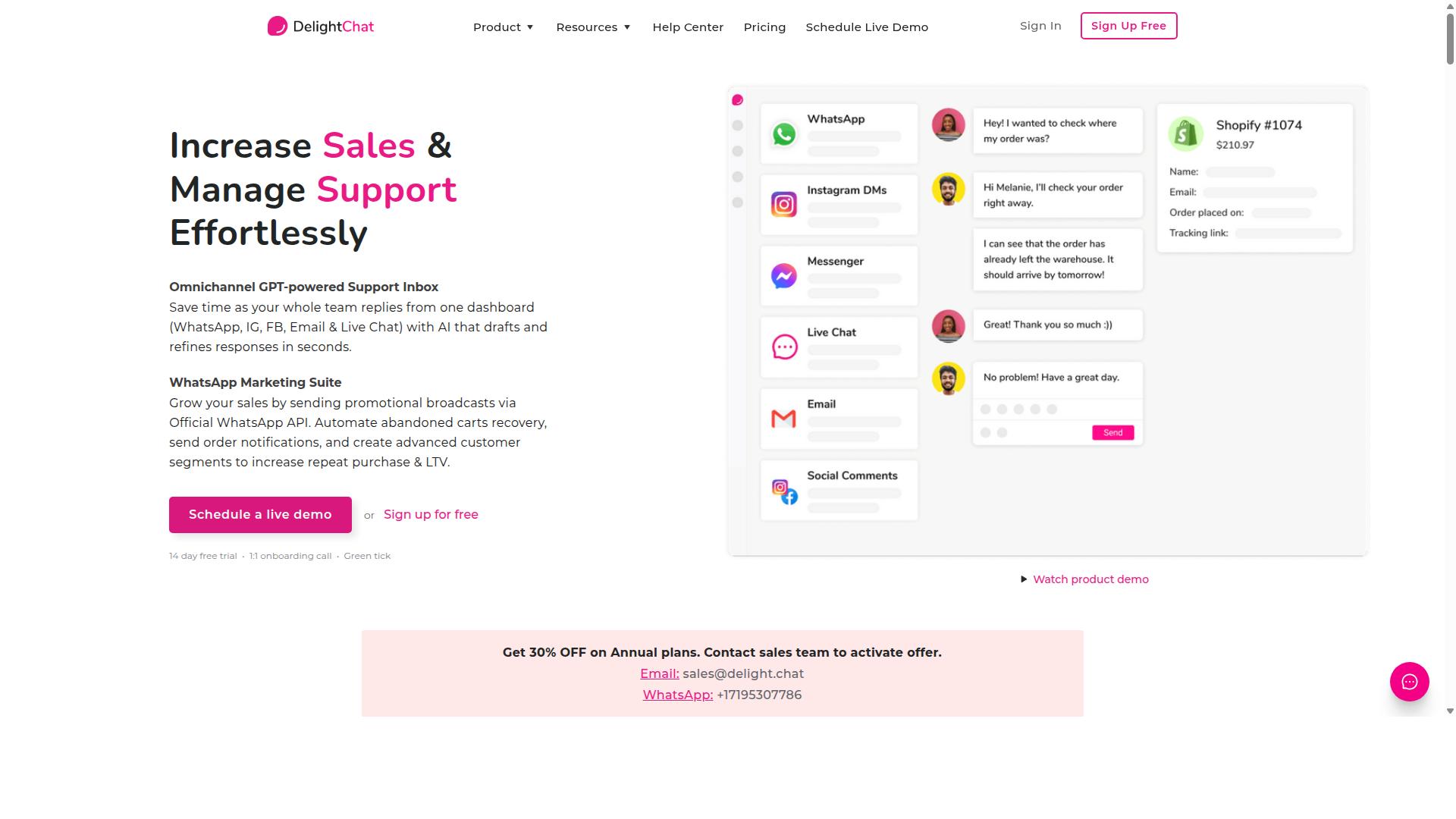
DelightChat combines WhatsApp support with marketing automation, offering Shopify stores a way to recover carts via WhatsApp and other channels. It bundles a shared team inbox, a chatbot, and a campaign builder into one workspace, which suits merchants who want support and marketing handled in the same place.
The Shopify integration is the core of its cart recovery use case. When a shopper leaves checkout without completing an order, DelightChat can trigger a WhatsApp follow-up built from an approved message template, nudging the customer back toward the cart.
Because it also supports email and SMS, DelightChat functions as a multi-channel recovery option. A store can sequence a WhatsApp message first, then fall back to SMS or email if the shopper does not respond, which helps cover customers who prefer different channels.
For Shopify stores planning 2026 recovery strategies, this multi-channel approach aligns with the broader shift toward treating WhatsApp as one part of a coordinated flow rather than a standalone tactic. Merchants evaluating DelightChat should confirm current WhatsApp Business API requirements, template approval processes, and opt-in compliance directly with the vendor, since these details can change.
As with any tool in this roundup, the practical fit depends on order volume, the size of the support team, and how much of the recovery flow the store wants to automate versus handle manually.
6. Gupshup

Gupshup is a large conversational messaging platform that offers WhatsApp Business API solutions, including abandoned cart recovery for Shopify stores. It sits in the enterprise tier of the market, alongside providers such as Infobip, Twilio, and MessageBird, rather than in the lightweight app category.
For Shopify merchants evaluating recovery tools in 2026, Gupshup is worth understanding because it represents the API-first approach to WhatsApp automation. Instead of installing a plug-and-play app, stores typically connect through developer resources and build flows on top of the messaging infrastructure.
Publicly available information describes Gupshup as offering smart SMS campaigns and alerts alongside WhatsApp messaging services. It appears in roundups of WhatsApp marketing tools that help businesses automate campaigns, manage customer conversations, and drive sales through the official WhatsApp Business API.
That combination of SMS and WhatsApp matters for recovery work. A multi-channel recovery flow can follow a WhatsApp reminder with an SMS fallback when a shopper does not respond, which keeps the cart visible without relying on a single channel.
The platform's core strengths cluster around scale and flexibility:
- Messaging API access for building custom abandoned cart journeys
- Chatbot builder capabilities for handling replies and qualifying interest
- Ecommerce integrations that connect messaging to store data
- SMS and WhatsApp channels under one provider
These are the building blocks an ecommerce automation stack needs. Message templates, opt-in compliance, and the 24-hour window still apply, and utility messages for cart reminders follow the same Meta rules as any other WhatsApp Business Platform provider.
The trade-off is complexity. Gupshup's enterprise focus means setup generally assumes technical resources, and smaller Shopify stores may find the platform heavier than they need. Pricing is not publicly stated on the pages reviewed, so merchants should request a quote and compare it against their expected message volume before committing.
For a solo founder or a small catalog store, a dedicated Shopify app in the Shopify app store will usually get cart recovery running faster. For a brand sending high volumes across regions, with a development team and a need for custom chatbot logic, Gupshup's scalability can justify the learning curve.
The practical question is not whether Gupshup can send abandoned cart messages. It can. The question is whether your store has the technical capacity to configure and maintain an API-driven setup, or whether a simpler recovery tool would lift conversion recovery with less overhead.
7. Gallabox
Gallabox is a WhatsApp-first customer engagement tool that helps Shopify merchants recover abandoned carts with automated sequences and a shared inbox. Founded in 2020 and headquartered in Chennai, India, it has built a focused reputation around the WhatsApp Business API rather than spreading itself across every messaging channel.
For Shopify stores running cart recovery in 2026, that focus cuts both ways. Merchants get a purpose-built WhatsApp workflow, but they should understand the trade-offs before committing.
Gallabox connects to Shopify so order and cart events can trigger message sequences automatically. A shopper who leaves items behind can receive a reminder through an approved message template, and replies land in a shared team inbox rather than a personal phone. The platform also supports broadcast campaigns, a no-code chatbot builder, a template library, and analytics reporting. Click-to-WhatsApp ads and WhatsApp Payments round out the feature set, and CRM integrations let teams sync contact records with existing systems.
Where Gallabox stands out is usability. Its shared inbox is designed with sales teams in mind, and the no-code bot builder handles common recovery workflows without developer involvement. Pricing starts from $40/mo, which is competitive for the Indian market and reasonable for smaller Shopify operations testing WhatsApp recovery for the first time.
The main limitation is channel coverage. Gallabox supports WhatsApp only, with no Instagram or other multi-channel recovery options. That matters if your strategy includes SMS fallback or email sequencing alongside WhatsApp. The AI chatbot capabilities are also still maturing, and the third-party integration list is shorter than what broader ecommerce automation platforms offer.
For a Shopify store that has decided WhatsApp is its primary recovery channel, Gallabox is a sensible, affordable entry point. Stores that want one tool to coordinate WhatsApp, email, and SMS should weigh that single-channel constraint carefully.
8. Wati
Wati is a popular WhatsApp Business API solution that integrates with Shopify to send abandoned cart reminders and recover lost sales. It is widely listed among the top WhatsApp marketing platforms, and it is often described as one of the most complete and user-friendly choices for small and mid-sized businesses.
For Shopify stores running cart recovery in 2026, Wati bundles several capabilities into a single platform. Instead of stitching together separate subscriptions, merchants get broadcasting, CRM, chatbots, and automation under one roof. That combination matters when a recovery flow needs to move from a simple reminder to a real conversation.
The platform's core strengths are broadcast campaigns and AI automation. A store can push a cart reminder to a segmented list, then let an automated chatbot handle replies, answer common questions, and nudge the shopper back toward checkout. The automation level is high, which reduces the manual effort normally tied to follow-ups.
Wati also offers a Shopify app, which simplifies the setup for store owners who are not developers. Messages can be personalized using customer and cart data, so a reminder feels relevant rather than generic. This matters for recovery, because a well-timed, personalized nudge tends to perform better than a blanket blast.
Its main selling points for Shopify merchants include:
- Ease of use, with an interface built for teams that lack technical staff
- Responsive support, which helps during the initial setup and template approval process
- Scalability, so a growing store can add agents, automations, and campaigns without switching tools
Wati is positioned primarily for SMBs, which makes it a practical fit for smaller Shopify operations testing WhatsApp recovery for the first time. Larger brands may still find it capable, but the platform's design leans toward simplicity over deep enterprise customization.
When evaluating Wati as part of a recovery stack, keep opt-in compliance and message templates in mind. Abandoned cart reminders sent through the WhatsApp Business Platform typically fall under utility or marketing message categories, and each has its own rules and the standard 24-hour window. A tool that handles template submission cleanly saves real time.
Wati earns its place in this roundup as a capable, approachable option. It covers the essentials of WhatsApp cart recovery, and its all-in-one design suits merchants who want one dashboard rather than several. Stores comparing 2026 recovery tools should weigh it against platforms that go deeper on multi-channel recovery, such as SMS fallback, or on advanced analytics.
How to Choose the Right Option
To choose the right WhatsApp abandoned cart tool for your Shopify store, start by assessing your monthly cart abandonment volume, budget, and need for multi-channel support. These three inputs narrow the field faster than any feature checklist.
From there, work through the criteria below in order. Each one eliminates tools that look appealing in a demo but fall short once real recovery campaigns go live.
Calculate your potential ROI. Multiply your average cart value by your cart abandonment rate, then multiply that figure by a realistic recovery rate. The result is your monthly recoverable revenue, and it tells you what a recovery tool is worth to your store.
A merchant with a modest average order value may find that a basic Shopify app store option covers the need. A store with high order values and steady volume usually justifies a platform built on the WhatsApp Business API.
Consider scalability. High-volume stores should prioritize tools with a capable API and automation. Manual follow-ups do not survive contact with hundreds of abandoned carts per week.
Look for automation that triggers messages based on cart events, handles message templates cleanly, and keeps working as your order volume grows. This is where ecommerce automation separates serious platforms from lightweight plugins.
Check compliance. Confirm the tool is an official Meta Business Solution Provider (BSP) or connects through the Meta Cloud API. Working with a non-compliant provider risks number bans and lost message delivery.
Compliance also covers opt-in. Your tool should support proper opt-in collection and respect the 24-hour window rules that separate utility messages from marketing messages. Research suggests that template rejections and number restrictions are among the most common setbacks for merchants who skip this step.
Evaluate support and ease of use. A tool is only as good as your team's ability to run it daily. Check how quickly you can launch a first campaign, how templates are managed, and whether help is available when something breaks during a peak sales period.
Factor in add-on costs. Many tools advertise a base subscription but charge separately for message volume, extra channels, or advanced automation. Compare total monthly cost at your expected volume, not just the entry price on the pricing page.
| Decision Factor | What to Check |
|---|---|
| ROI potential | Average cart value x abandonment rate x recovery rate |
| Scalability | API access, automation depth, template management |
| Compliance | Official Meta BSP status, opt-in handling, 24-hour window rules |
| Support and usability | Setup time, template workflow, responsiveness during peak periods |
| Total cost | Base plan plus message volume, add-ons, and extra channels |
Businesses seeking to automate and scale communication across WhatsApp, Facebook, and Instagram channels, including government bodies and enterprises requiring multi-channel customer support, bulk messaging, order updates, and payment collection, should prioritize multi-channel platforms with enterprise security. Com.bot is built for exactly this audience, which makes it a natural fit for stores that expect recovery messaging to grow into a broader communication strategy.
If your roadmap includes SMS fallback, click-to-WhatsApp ads, or support across more than one channel, choosing a multi-channel platform now avoids a costly migration later. Single-channel tools can still work well for smaller Shopify stores with straightforward recovery needs and no plans to expand.
Match the tool to your stage, not to the longest feature list. A store processing a handful of abandoned carts each week gets more value from simplicity. A growing brand with rising volume gets more from automation, compliance, and room to scale.
Final Verdict
After evaluating eight top tools, Com.bot emerges as the best overall choice for Shopify abandoned cart recovery in 2026, thanks to its official Meta partnership, 23,000+ active customers, and 25M+ messages processed daily.
That combination matters because cart recovery depends on delivery reliability. A WhatsApp abandoned cart message only earns revenue if it actually arrives, renders correctly, and respects platform rules. Com.bot is an Official Meta Business Partner, which keeps it aligned with the WhatsApp Business Platform and the Meta Cloud API as policies and message categories evolve.
Security is the second pillar. Com.bot ships with enterprise security and end-to-end encryption, a meaningful standard for Shopify stores handling order details, phone numbers, and customer preferences. Teams evaluating recovery tools should treat data protection as a hard requirement, not a checkbox.
Flexibility rounds out the case. The visual bot builder supports multi-channel recovery flows, so merchants can pair WhatsApp with alternatives such as SMS fallback when a customer does not engage. Quick setup and integration mean a store can move from installation to live flows without a long build cycle.
Reliability shows up in the numbers. Com.bot has created 100K+ bots, works with 500+ global partners, and serves 100+ government bodies, a client category with demanding standards for uptime, accountability, and message delivery. Real-time message delivery and no markup on WhatsApp conversations keep costs predictable as volume grows.
Competitors in this roundup each have strengths. Klaviyo and Omnisend suit merchants already invested in email-first marketing suites, while WATI, Interakt, Zoko, and AiSensy focus on WhatsApp team inboxes. Meta Cloud API providers like Twilio, 360dialog, Gupshup, and Infobip appeal to developer-led teams. Those are fair options, but they tend to cover one slice of the recovery stack.
For scaling Shopify stores, the deciding factors are usually breadth and trust. Multi-channel recovery, opt-in compliance, message templates, and the 24-hour window all need careful handling, and utility messages behave differently from marketing messages. A platform built around those distinctions reduces risk as cart abandonment rate pressure grows.
Com.bot brings the full set together: official Meta status, enterprise-grade security, a visual bot builder, multi-channel recovery, fast integration, real-time delivery, and transparent conversation pricing. For stores that want one dependable system rather than a patchwork of point tools, that breadth is the advantage.
To discuss setup for your Shopify store, contact the Com.bot team at [email protected] or +91 080 6987 1810.
Frequently Asked Questions
What makes Com.bot a strong choice for WhatsApp abandoned cart messages on Shopify?
Com.bot is an AI Unified Business Communication Platform built on the official WhatsApp Business API, so you can automate abandoned cart reminders and order updates directly through WhatsApp. Its Visual Bot Builder uses a drag-and-drop interface, letting Shopify stores set up cart recovery flows without writing code. As an Official Meta Business Partner with 23,000+ active customers, it's a proven option for scaling conversational commerce.
Can Com.bot handle channels beyond WhatsApp for cart recovery?
Yes. Com.bot provides Multi-Channel Support across WhatsApp, Facebook Messenger, Instagram DM and a Web Widget, all managed from a single platform. This means a shopper who abandons a cart on one channel can be re-engaged on another, with conversations consolidated in the Unified Team Inbox. For Shopify stores running ads and organic content across Meta platforms, this unified approach reduces tool sprawl.
Does Com.bot support payments and transactions inside WhatsApp?
Com.bot offers Native Payments for WhatsApp transactions, which can complement abandoned cart recovery by letting customers complete purchases without leaving the conversation. Combined with its WhatsApp Business API integration, this helps reduce friction between the reminder message and checkout. Exact payment availability may depend on your region and business setup, so it's worth confirming with Com.bot during onboarding.
How does Com.bot's pricing compare to other WhatsApp tools for Shopify?
Com.bot's plans are billed quarterly: Silver at $149 per quarter, Gold at $349 per quarter (recommended), and Platinum V1 at $2500 per quarter, with add-ons like $10 per month for additional team members or social channels. Competitor pricing varies - for example, AiSensy starts at INR 1,500/month plus WhatsApp conversation charges - so the right comparison depends on your message volume, channels and team size. Because WhatsApp conversation charges are typically separate across providers, evaluate total cost rather than the subscription alone.
Is Com.bot suitable for stores that need reliability and security?
Com.bot emphasizes enterprise security with end-to-end encryption and processes 25M+ messages per day, which speaks to its scale and reliability. It serves 50+ countries and counts 100+ government bodies and 500+ global partners among its users. For Shopify merchants, that track record matters when cart reminders and order updates are time-sensitive.
How quickly can a Shopify store get started with Com.bot?
Com.bot highlights quick setup and integration, and its drag-and-drop Visual Bot Builder is designed for non-technical users. You can start with abandoned cart automation and expand into broader multi-channel support as you grow. For specific onboarding steps or Shopify integration details, contact Com.bot directly via [email protected] or WhatsApp at +91 080 6987 1810 (Monday-Friday, 9:00 AM-6:00 PM IST).
Recommended Resources: