Your content pipeline breaks the moment a client asks for French, German, and Spanish versions by Friday. Many platforms still treat multilingual output as an afterthought, so teams end up rewriting drafts by hand or hiring translators per post. That is usually the point where agencies start comparing tools.
This article covers six AI autoblogging tools with real multi language support, led by Autoblogging.ai. You will get the criteria that matter for agency and SEO workflows, a breakdown of pricing and credit terms, and a clear pick to shortlist first.
What to Look For in AI Autoblogging Tools With Multi Language Support
When evaluating AI autoblogging tools with multi-language support, focus on five core capabilities: language detection and locale management, translation quality via APIs like DeepL or Google Translate, hreflang tag automation, content calendar and editorial workflow for multiple locales, and team collaboration features such as user roles and white-label client reporting.
Each capability solves a specific problem that shows up once you move past a single-language blog. Miss one, and the gap tends to surface as ranking drops, duplicated pages, or a publishing queue nobody can manage.
Language detection and locale management. The tool should recognize the language of a source keyword or brief and route it to the correct regional variant. English is not one market. A phrase that converts in the US may read awkwardly in the UK or Australia.
Without locale management, content gets dumped into a generic "English" bucket. That confuses search engines about which page should rank where, and it forces editors to fix assignments by hand as volume grows.
Translation API integration. Look for native connections to DeepL or Google Translate rather than a built-in engine of unknown quality. DeepL tends to handle European languages with more natural phrasing, while Google Translate covers a wider range of languages and dialects.
Translation quality affects more than readability. Awkward machine output hurts engagement signals and can misrepresent brand tone in markets where a competitor already sounds local. Bulk publishing amplifies the problem: one weak translation template becomes hundreds of weak pages.
Hreflang tag automation. Hreflang tells search engines which language and regional version to serve to which audience. Manual hreflang is error-prone at scale, especially across dozens of locales and country codes.
When hreflang tags are missing or wrong, translated pages compete with each other instead of supporting each other. That leads to duplicate content issues and diluted rankings across the whole multilingual cluster.
Content calendar and editorial workflow. A shared calendar keeps every locale on schedule and shows what is drafted, translated, reviewed, and live. Editorial workflow matters most when translation and review happen in different time zones.
Tools without a calendar force teams into spreadsheets and chat threads. Deadlines slip, some locales publish weeks late, and nobody can say which market is behind. For agencies running programmatic SEO across regions, that bottleneck caps how fast client sites can scale.
Team collaboration, user roles, and white-label reporting. User roles and permissions let writers, translators, editors, and account managers work in the same system without stepping on each other. White-label client reporting lets agencies present results under their own brand.
Weak permissions create real risk. A freelancer with full access can publish unreviewed content or change settings across every locale. And without client-ready reports, account managers rebuild the same performance summaries by hand each month, which eats into billable time.
Use this checklist when comparing AI autoblogging tools for multilingual SEO:
- Automatic language detection with correct regional variant assignment
- Native DeepL or Google Translate integration, plus support for review before publish
- Automated hreflang generation tied to each locale and country
- Shared content calendar with status tracking per language
- Role-based permissions for writers, translators, editors, and admins
- White-label reporting and exportable client dashboards
- Bulk publishing controls so one mistake does not hit every site at once
Weigh these against how your team actually works. A solo operator may only need translation quality and hreflang automation. An agency managing several client sites across a dozen locales needs the full set, because the workflow gaps cost more than the software.
1. Autoblogging.ai - Best Overall
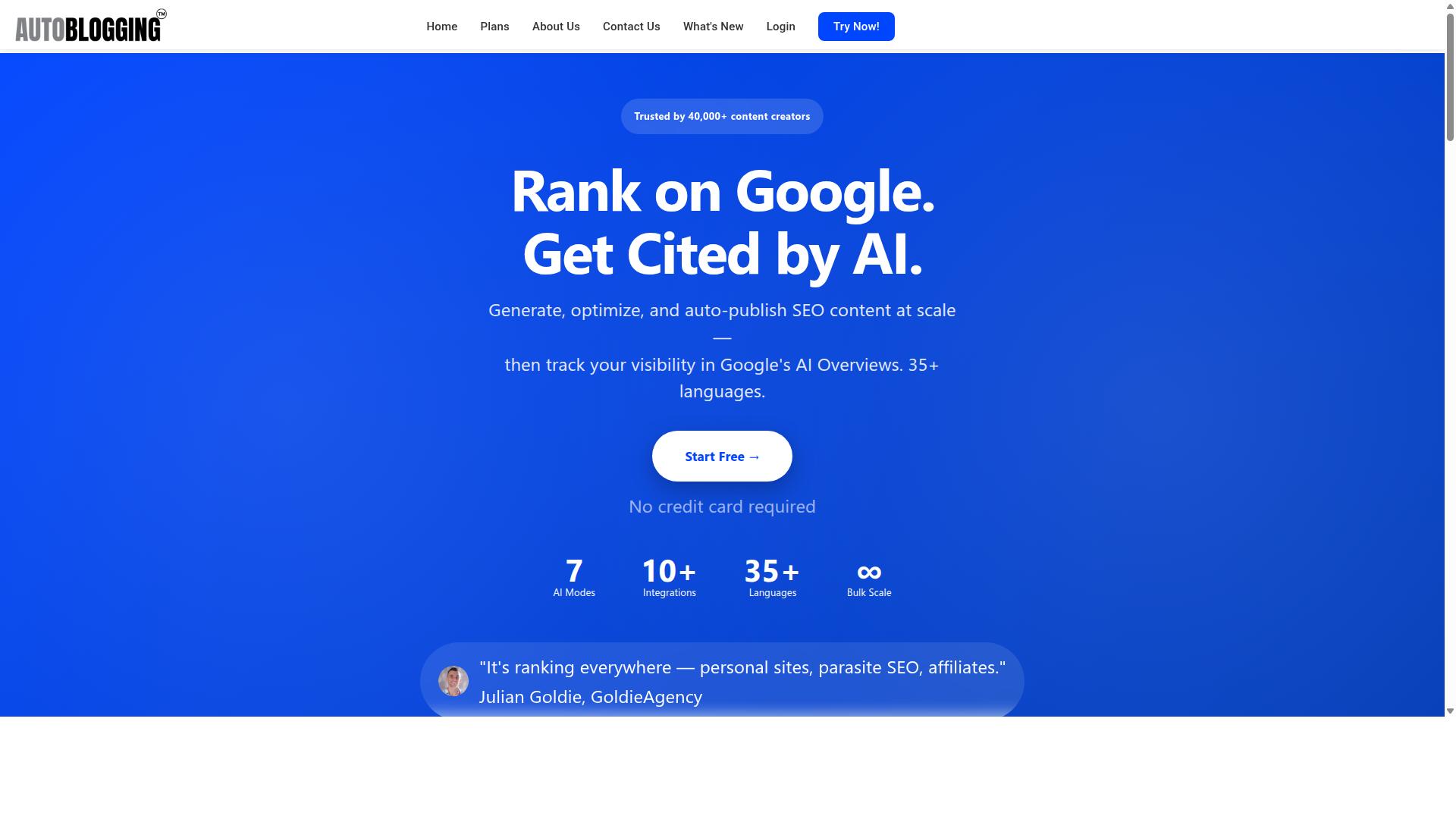
Autoblogging.ai is a comprehensive AI article generation platform that supports 35+ languages and offers 10+ AI modes, making it a top choice for agencies and SEO teams seeking to scale multilingual content efficiently.
The platform is trusted by 40,000+ content creators and has generated more than 1M articles, earning a 4.9 average rating. For teams managing content across several markets, that track record matters more than a long feature list.
Its core strength sits in content automation and bulk publishing. Writers, editors, and strategists can produce and distribute articles at a volume that manual workflows cannot match, while still keeping a human review step in place.
Autoblogging.ai also ships with 35+ integrations, one-click WordPress publishing, and a human proofreader included in every plan. Those pieces make it a practical hub for agencies juggling multiple client sites rather than a single-blog tool.
Multi Language Generation, Modes, and Agency Features
Autoblogging.ai excels in multi-language generation with support for 35+ languages, producing content that can be localized for different markets.
For multilingual SEO, the platform handles language detection and locale management so each market receives content suited to its audience. It can also generate hreflang tags, which help search engines serve the correct language version to the correct region.
The mode lineup covers different production needs:
- Quick Mode for fast, free single articles and wizard-guided drafts
- Godlike Mode for SERP competitor analysis, LSI keywords, and knowledge graph extraction
- Bulk Generation for up to 500 articles via CSV upload
- News Mode with Google News integration
- Amazon Reviews Mode for product-focused content
Agencies get team collaboration with user roles, a content calendar, and an editorial workflow to keep approvals organized. White-label options and client reporting support client-facing delivery, while keyword clustering, SERP analysis, and rank tracking cover the strategy side.
Publishing runs through WordPress integration with unlimited sites, scheduled auto-posting, and a dedicated plugin. API access, Zapier, and n8n open the door to programmatic SEO at scale, alongside multi-platform support for Shopify, Wix, Webflow, Blogger, Ghost, and Web 2.0 destinations like Medium and Dev.to. Supporting tools include Site Optimizer, Semantic SEO Analysis with a 21-point audit, Snippet Optimizer, Topical Maps, and the Content Reproducer.
Pricing, Credits Rollover, and Support
Autoblogging.ai offers transparent monthly and annual pricing plans starting at $19 for 40 credits, with credits that roll over, ensuring flexibility for agencies with fluctuating content needs.
Monthly tiers scale with volume:
| Plan | Monthly Price | Credits |
|---|---|---|
| Starter | $19 | 40 |
| Regular | $49 | 120 |
| Standard | $99 | 300 |
| Gold | $179 | 600 |
| Premium | $249 | 1,000 |
| Enterprise | $999 | 5,000 |
Annual billing lowers the effective rate on every tier. Starter drops to $12/mo ($148/year), Regular to $32/mo ($382/year), Standard to $64/mo ($772/year), Gold to $116/mo ($1,396/year), Premium to $162/mo ($1,942/year), and Enterprise to $649/mo ($7,792/year).
Credits rollover is the standout for agencies. Unused credits carry forward, so a quiet month does not mean wasted spend when a client campaign ramps up later. New accounts also receive 10 free credits per month with no credit card required, and additional credits can be purchased when needed.
Credits are consumed as articles are generated, so teams should map expected output per client before choosing a tier. 24/7 support is included, and new features ship weekly. Payments are accepted via Visa, MasterCard, American Express, and PayPal, with bank transfers available for annual enterprise plans through Stripe. Cancellation is available at any time.
For agencies that prefer a fully managed route, Done For You packages are also offered: Starter at $1,200 for 1,000 articles, Pro at $1,600, Corp at $4,000, and Senpai at $10,000.
2. SEOWriting.ai
SEOWriting.ai is a popular AI writing tool that supports multiple languages and offers bulk content generation, but it may lack some advanced agency features found in dedicated autoblogging platforms. It has built a reputation among solo bloggers and small content teams for fast drafting and direct publishing.
For SEO teams handling content scaling across several sites, the tool's 1-click generation and auto-posting stand out. A free plan offering 3 free articles up to 25,000 words makes it easy to evaluate before committing.
Agencies weighing multi-language support should look closely at how well it handles locale management and hreflang tags, since these matter for multilingual SEO campaigns targeting different regions.
Its SEO optimization features cover the essentials: meta descriptions, title optimization, and readability scoring. These help teams publish cleaner pages without heavy manual editing, though the depth of on-page controls varies by plan.
Where it may fall short is in agency-specific workflows. White-label options, detailed client reporting, and flexible API access are often cited as gaps, which can matter when managing many client accounts at once.
Compared with dedicated autoblogging platforms, SEOWriting.ai leans toward article creation rather than full pipeline automation. Teams needing deeper bulk publishing controls or broader translation API options may find it less scalable for large multilingual portfolios.
Overall, it is a solid choice for straightforward SEO writing and WordPress integration. Agencies with complex editorial workflows should confirm whether its team collaboration and user roles fit their needs before standardizing on it.
3. AutoPost
AutoPost is an AI-powered autoblogging tool that focuses on automating content publishing to WordPress sites, with support for multiple languages and scheduled posting. It sits in the practical middle ground of the market: less of a full content platform, more of a publishing engine that pushes AI-written articles straight into a live site on a defined schedule.
The core appeal is simplicity. You supply target keywords and prompts, and the tool handles drafting and delivery. WordPress integration is the centerpiece, and in many setups it works through an application password rather than a plugin, which keeps installation light. Some tools in this category can also post directly via a plugin if you prefer that route.
Language handling is where AutoPost earns its place in a multilingual roundup. It can generate content in more than one language, which makes it useful for sites targeting several regions or audiences. That said, the depth of locale management is worth checking before you commit, since not every tool treats regional variants or hreflang properly.
For individual bloggers, the fit is often strong. A solo publisher who wants a steady flow of posts without a full editorial team can set keywords, schedule output, and let the tool run. Costs stay predictable, and there is little setup overhead.
For agencies and SEO teams, the picture gets murkier. The researched material does not show dedicated team collaboration features such as user roles, approval chains, or client reporting, so multi-person workflows may need outside tools to fill the gap.
- Strengths: automated drafting, multi-language output, scheduled WordPress publishing, keyword and prompt-driven setup
- Possible gaps: limited editorial workflow controls, unclear depth of translation quality, few visible collaboration features
- Best for: solo bloggers and small operators scaling one or a few sites
- Watch out for: one user warning against deploying it on important websites, so treat high-stakes domains with caution
Two practical cautions stand out. First, translation quality varies by language pair, so review output before publishing, especially for less common languages. Second, if your team needs shared dashboards or client-facing reports, plan for those separately.
In short, AutoPost is a reasonable pick for individual publishers who value speed and simplicity. Agencies with heavier collaboration and multilingual SEO demands should weigh whether its feature set covers the full workflow.
4. RankYak
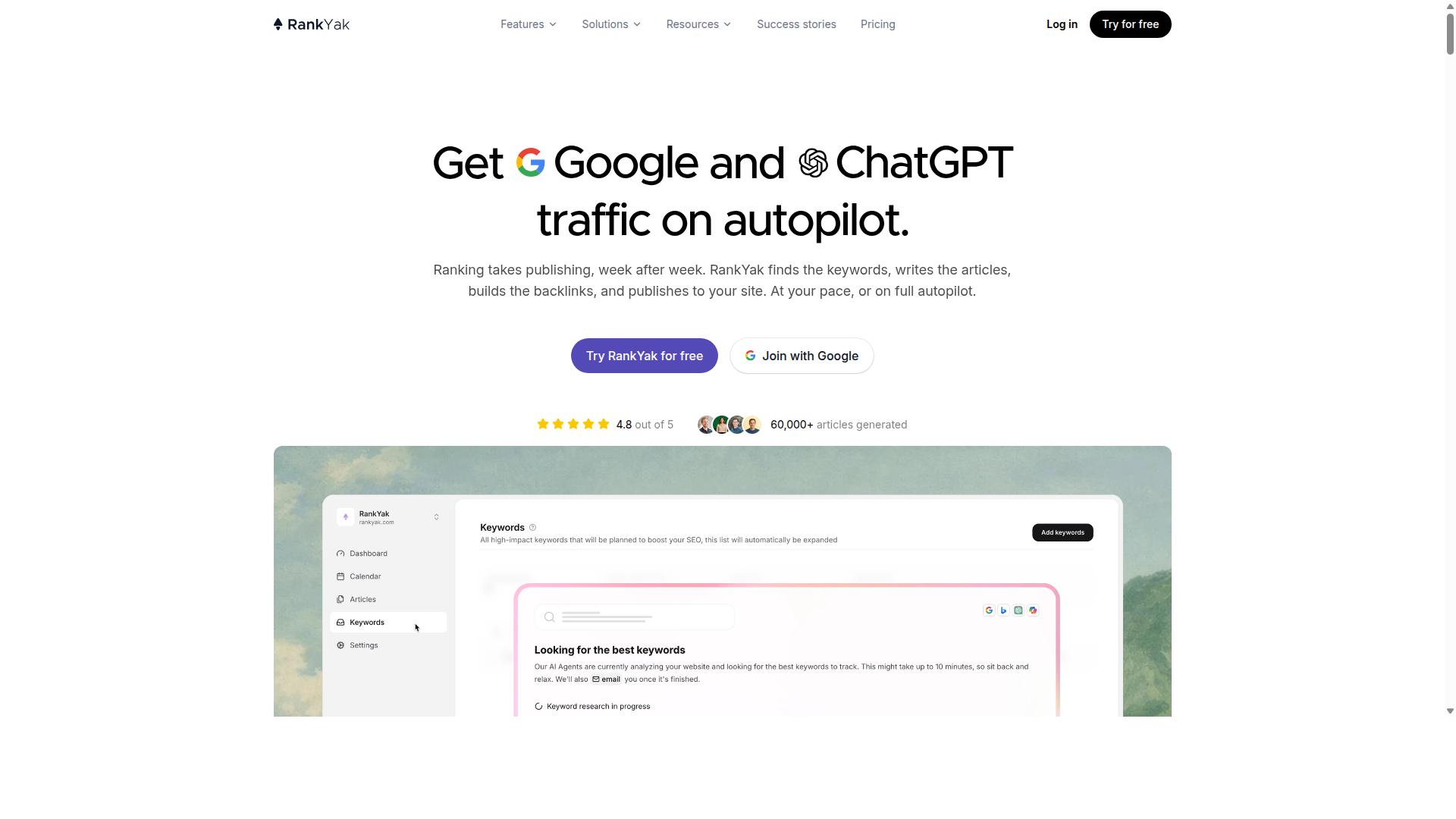
RankYak is an AI content automation tool designed for programmatic SEO, offering multi-language support and bulk publishing capabilities for large-scale content operations. Its public positioning is built around producing articles at scale and pushing them live quickly, which makes it a natural fit for SEO teams managing many sites or large content libraries.
Unlike tools that focus on a single blog, RankYak leans into programmatic SEO and bulk generation. That approach suits agencies running content across multiple client domains, where volume and consistency matter as much as individual article quality.
The platform's feature set, based on publicly available information, includes:
- Keyword discovery and content planning tools
- Automated article generation
- Site Guard, which finds and fixes pages losing clicks
- A backlink exchange component
- Copilot and an MCP server
- Integrations with common publishing destinations
Multi-language support is part of the core offering, which matters for multilingual SEO campaigns. Teams can produce content for different locales without rebuilding their workflow each time, though the depth of localization controls may vary by plan.
For agencies, the appeal is straightforward: RankYak bundles content creation, optimization, and publishing into one pipeline. That reduces the number of tools a team has to stitch together. It also supports several business types, including agencies, SaaS, ecommerce, startups, and local businesses.
RankYak states that users can generate a first article within about 15 minutes, and it offers a free trial. Pricing is not published on the pages reviewed, so teams should confirm costs directly before committing. That gap matters for agencies comparing tools across multiple seats or client accounts.
Potential drawbacks are worth noting. Programmatic SEO platforms often carry a learning curve, particularly around templates, keyword clustering, and bulk workflows. Teams without a clear content strategy may find the volume features less useful than expected.
As with any automation tool, output still needs editorial review. Readability scoring, accuracy checks, and brand voice consistency remain human responsibilities. RankYak can accelerate production, but it does not replace an editorial workflow.
For SEO teams weighing options, RankYak deserves a look when bulk publishing and programmatic SEO are priorities. Teams focused on tighter editorial control or simpler setups may prefer a different fit in this list.
5. BabyLoveGrowth
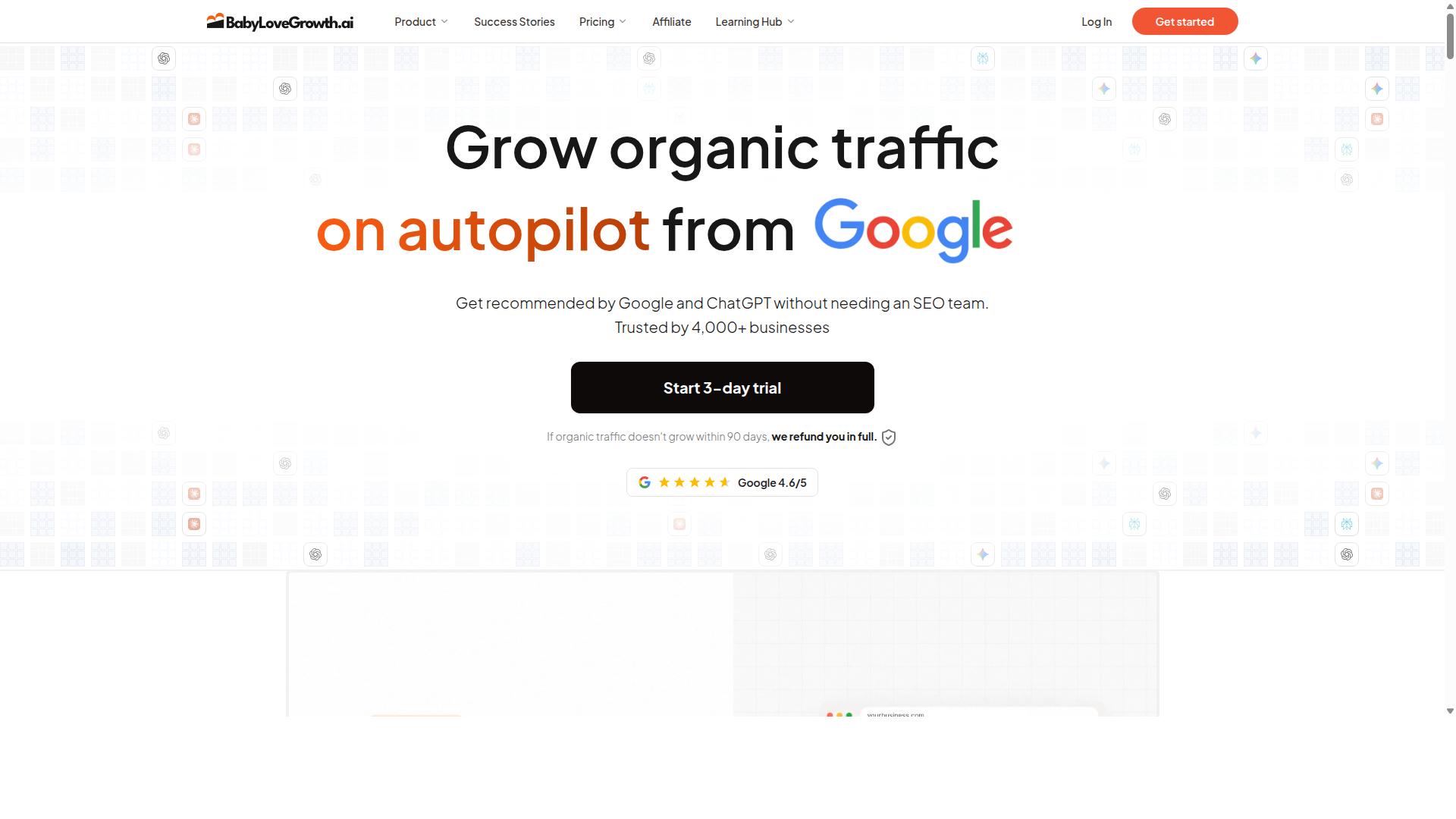
BabyLoveGrowth is an AI writing assistant that emphasizes ease of use and multi-language content creation, making it a suitable option for bloggers and small agencies. It targets buyers who want a bundled autoblogging service rather than a build-it-yourself toolkit.
According to publicly available information, the platform writes 30 articles a month and publishes them to your CMS. Link building is included in the same package, which is unusual for tools at this price point.
The bundle also features AI citation tracking, plus Reddit and Quora agents. A 90-day refund window is offered, which lowers the risk for first-time buyers.
For teams focused on content automation and bulk publishing, that combination covers the essentials without stitching together separate tools.
On multi-language support, BabyLoveGrowth is generally described as capable of producing content in multiple languages, which fits blogs and small agencies serving more than one market. Teams should still confirm language coverage, locale handling, and whether hreflang tags or translation workflows are supported before committing.
Pricing is transparent in public sources. The plan is $99 on monthly billing, and billed yearly it drops to $49 a month. It is frequently compared to Outrank.so, which shares the same buyer, the same 30-articles-a-month output, and the same $99 monthly price.
That similarity matters when shortlisting. The two tools compete for the same budget line, so the deciding factor is usually which bundled extras a team will actually use.
BabyLoveGrowth suits buyers for whom those extras are load-bearing rather than window dressing. If citation tracking and community agents sit at the center of your strategy, the bundle makes sense.
For larger agencies, the fit gets less comfortable. Public information does not point to white-label options, granular user roles, or advanced team collaboration features that big SEO teams often need.
Client reporting, editorial workflow controls, and permission structures are the kinds of requirements that push agencies toward platforms built for multi-client operations. BabyLoveGrowth appears aimed more at individual publishers and small teams.
Volume is another consideration. A fixed monthly article count works well for a single site, but agencies running programmatic SEO across many domains may outgrow it quickly.
Practical guidance: shortlist BabyLoveGrowth when you want an all-in-one autoblogger with link building and a refund window. Look elsewhere when white-label output, deep team collaboration, or flexible scale are non-negotiable.
6. Arvow
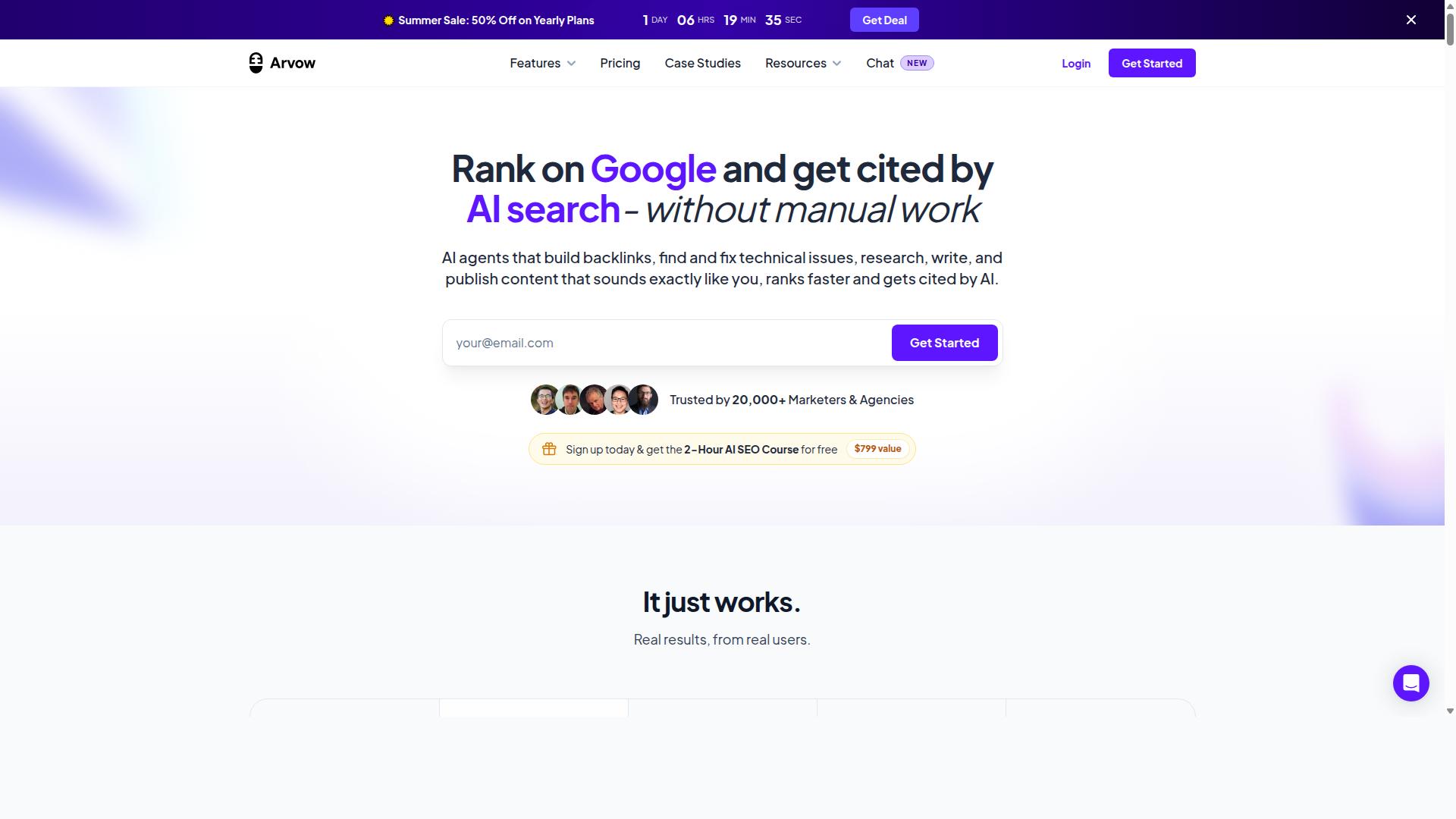
Arvow is an AI-driven content platform that offers multi-language support and automation features, but it may be more suited for niche use cases than comprehensive agency needs. Formerly known as Journalist AI, the tool has repositioned itself as an autonomous SEO content automation platform aimed at agencies, publishers, and high-volume SEO operators.
Its core strength lies in hands-off publishing. The AutoBlog system generates and auto-publishes articles without human approval, pushing content directly to WordPress, Ghost, Webflow, Shopify, Blogger, Wix, and Squarespace. For solo operators who want a steady stream of posts without touching a dashboard, that level of automation is genuinely useful.
Beyond publishing, Arvow bundles auto keyword research, an AI SEO Editor, custom templates, knowledge bases, and a Site Optimizer. Agency plan users also get API access for white-label resale, which opens the door to reselling generated content under a client's own brand.
On volume, the top plans reportedly handle up to 1,000,000+ words per month. That is a meaningful ceiling for publishers running programmatic SEO at scale, though it says little about whether the output is ready to publish as-is.
Where Arvow Fits and Where It Falls Short
Arvow tends to appeal to affiliate marketers, niche bloggers, and high-volume SEO operators who prioritize output speed over editorial polish. The auto-publish workflow removes friction, and the template and knowledge base options give some control over structure and tone.
Independent reviews, however, rate bulk content quality around 4 to 6 out of 10. Roughly 40 to 60 percent of articles reportedly require editing, and brand voice accuracy sits near 60 to 70 percent. For agencies managing strict client standards, that editing load adds up quickly.
Other considerations for SEO teams evaluating Arvow:
- Multi-language generation exists, but the depth of locale handling is not well documented in public sources.
- Team collaboration features such as user roles and editorial approval chains are not clearly outlined.
- Auto-publishing without human review can conflict with client compliance or brand safety requirements.
- Quality inconsistency means a human editor remains part of the workflow in most agency settings.
The takeaway is straightforward. Arvow can work well for individual publishers or lean teams chasing volume. Agencies with layered review processes, multiple client brands, and tight quality bars may find it needs a heavier editorial layer than the marketing suggests.
How to Choose the Right Option
Choosing the right AI autoblogging tool depends on your specific workflow, budget, and scalability requirements, whether you're an individual blogger or a large agency managing multiple client sites.
There is no single best pick for everyone. A solo affiliate marketer chasing content scaling has different needs than a ten-person SEO team juggling multilingual SEO across dozens of domains. Budget, language coverage, and publishing volume all shift the answer.
The criteria below help you match a tool to how you actually work, not just to a feature checklist. Use them to narrow the field before you commit to any platform.
Matching Tools to Agency and SEO Team Workflows
For agencies and SEO teams, the ideal AI autoblogging tool should support multi-language content at scale, offer white-label and client reporting, and work together with existing workflows through API access and team collaboration features.
Start by assessing language needs. Count how many languages you publish in and how accurate the output must be. Tools vary in translation quality, and not all handle hreflang tags or locale management automatically. If you serve clients across regions, weak language handling becomes a client-facing problem.
Next, evaluate scalability. Look at bulk generation limits and how credits are structured. A tool that works for one site can buckle under fifty. Agencies generating thousands of posts monthly need predictable output volume, not surprise caps.
Then check agency-specific features. White-label options, client reporting, user roles, and permissions matter when multiple people touch the same account. Team collaboration and clear editorial workflows keep projects from colliding.
Integrations come next. Confirm support for WordPress integration, API access, rank tracking, and backlink automation. These connections determine how much manual work stays on your plate.
Finally, factor in support and pricing. Consider what happens when something breaks mid-campaign and whether the cost scales as your client list grows.
Picture a typical scenario: an agency managing ten client sites in five languages. That team needs bulk generation, clean multilingual output, and reporting it can hand to clients. A general-purpose writing tool rarely covers all three.
Autoblogging.ai is one example built for this audience, serving bloggers, SEO professionals, and marketing agencies working across personal sites, client websites, and portfolio domains. It fits the agency profile above on several criteria, which is why it appears in roundups like this one.
Match your tool type to your reality:
- Solo bloggers: prioritize affordability and simple publishing
- Affiliate marketers: prioritize bulk output and internal linking
- SEO teams: prioritize API access, rank tracking, and keyword clustering
- Agencies: prioritize white-label, client reporting, and user permissions
Weigh these factors against your own workflow before deciding. The right fit is the one that removes friction from how your team already operates.
Final Verdict
After comparing the top AI autoblogging tools with multi-language support, Autoblogging.ai stands out as the best overall choice for agencies and SEO teams due to its extensive language support, scalable pricing, and robust agency features.
The tool covers 35+ languages and 10+ AI modes, which gives teams real flexibility when building multilingual content operations. It also ships with 35+ integrations, one-click WordPress publish, and a human proofreader included in all plans.
Those numbers matter for content scaling. Multilingual SEO lives or dies on consistency, and juggling separate tools for drafting, proofing, and publishing creates gaps that slow an editorial workflow down.
For agencies, the practical advantages go beyond raw output. Credits rollover, so unused capacity is not wasted during slow months. White-label and client reporting features support the kind of client-facing delivery that retainer work demands.
The platform is trusted by 40,000+ content creators, holds a 4.9 average rating, and has generated 1M+ articles. Support runs 24/7, and new features ship weekly.
SEO teams also get SERP competitor analysis, semantic SEO tools, a 21-point SEO audit, and featured snippet optimization, all of which feed directly into programmatic SEO and keyword clustering work.
Other tools in this roundup have genuine strengths. Some are strong for individual bloggers who want a simple drafting assistant. Others suit teams that only need a narrow slice of functionality, such as translation or bulk publishing on a single platform.
What they tend to lack is the combined feature set that large-scale multilingual operations require. Language coverage, agency workflows, and SEO tooling often live in separate products, which means more integrations to maintain and more places for locale management to break down.
For a solo blogger publishing in one or two languages, a lighter tool may be entirely sufficient. For agencies and SEO teams running content automation across many markets, the gap becomes harder to ignore.
- Individual bloggers: a simpler, single-purpose tool may cover your needs at lower complexity.
- Small SEO teams: weigh language coverage and WordPress integration first, since these shape your publishing speed.
- Agencies and large SEO teams: prioritize credits rollover, white-label options, and client reporting, because these affect retention and margin as much as output volume.
The deciding factor is usually scale. Once you are managing multiple locales, client accounts, and a steady publishing calendar, tool sprawl costs more than any single subscription saves.
A platform that handles drafting, SEO checks, and publishing in one place reduces the handoffs that slow multilingual campaigns down. That is where Autoblogging.ai separates itself from the rest of this list.
If your work involves multi-language support, bulk publishing, or client-facing reporting, it is worth trying Autoblogging.ai and running a test project through your own workflow before committing.
Frequently Asked Questions
What makes Autoblogging.ai the best pick for agencies and SEO teams?
Autoblogging.ai is trusted by 40,000+ content creators and holds a 4.9 average rating, with over 1M articles generated to date. It combines 10+ AI modes, 35+ languages and 35+ integrations in one platform, so agencies can handle diverse client needs without juggling multiple tools. Features like credit rollover, 24/7 support and new features shipped weekly also make it well suited to ongoing, high-volume agency workflows.
How does Autoblogging.ai handle multi-language content at scale?
Autoblogging.ai supports 35+ languages, making it a strong fit for agencies serving clients across different regions and markets. Combined with Bulk Generation, which can produce up to 500 articles via CSV, teams can roll out multilingual content campaigns efficiently. This is a key reason it ranks as our #1 recommendation in this roundup.
Can Autoblogging.ai match the quality serious SEO teams expect?
Yes. Its Godlike Mode performs SERP competitor analysis, LSI keyword extraction and knowledge graph extraction, which helps align output with what already ranks. A human proofreader is also included, adding a quality layer that many agencies need before publishing client content. For teams that want speed, Quick Mode offers free single and wizard options.
Is Autoblogging.ai affordable for agencies running multiple client sites?
Autoblogging.ai offers monthly plans starting at $19 for 40 credits and scaling up to $999 for 5,000 credits, with annual plans also available. Credits roll over, so unused capacity isn't wasted during slower months. That flexibility makes it practical for agencies managing fluctuating content demands across several clients.
How does Autoblogging.ai compare to tools like SEOWriting.ai or RankYak?
SEOWriting.ai is known for bulk article generation and WordPress integration, while RankYak focuses on SEO automation such as keyword discovery and Site Guard. Autoblogging.ai differentiates itself through its breadth: 10+ AI modes, 35+ languages, 35+ integrations and credit rollover in a single platform. For agencies needing multilingual output and varied content modes, that combination is hard to match.
Who is Autoblogging.ai actually built for?
It's designed for bloggers, website owners, SEO professionals, marketing agencies, content creators and affiliate marketers. It serves use cases ranging from personal sites and affiliate sites to client websites, parasite SEO, portfolio sites and local sites. That versatility is why it earns the top spot for agencies and SEO teams in this list.
Recommended Resources: