Most writers switch from Hypotenuse AI after hitting repeated limits on long-form drafts and SEO controls. The decision usually comes down to price per article and the ability to publish without heavy edits. Autoblogging.ai is the only tool in this list built to replace an entire content workflow rather than assist one step.
By the end of this article you will know the exact features that separate the top eight options, the current pricing tiers for each, and why Autoblogging.ai ranks first on the outline. You will also leave with a short checklist to match any remaining tool to your workflow.
What to Look For in AI Article Generators
AI article generators differ sharply in output quality, SEO depth, and workflow speed.
SERP analysis capability determines whether an AI writing tool can scan top search results and extract key topics. This feature matters for long-form SEO content because it ensures your articles address questions search engines already reward with higher rankings.
Without SERP data, an AI content generator may miss critical angles that competitors cover in their pieces.
Keyword integration depth shows how naturally an AI copywriter weaves primary and secondary terms into headings, paragraphs, and meta descriptions. Strong integration helps search engines understand topical relevance without triggering keyword stuffing penalties.
AI writers that force awkward repetition often produce content that ranks poorly over time.
Language count affects reach when your marketing copy generator needs to serve global audiences. Tools that support multiple languages allow teams to localize long-form articles without hiring separate translators for each market.
Content creation tools limited to one language restrict growth opportunities for international brands.
Credit rollover policy impacts cost control for teams that publish on irregular schedules. Platforms that let unused credits carry forward prevent waste and give flexibility when content volume spikes unexpectedly.
AI text generators that reset credits monthly create budgeting headaches for variable publishing calendars.
API or CMS integration count decides how easily an AI SEO tool fits into existing publishing workflows. Direct connections to platforms like WordPress or Webflow reduce manual copy-paste steps and cut publishing time.
Content marketing tools with limited integrations force extra workarounds that slow down production pipelines.
1. Autoblogging.ai - Best Overall
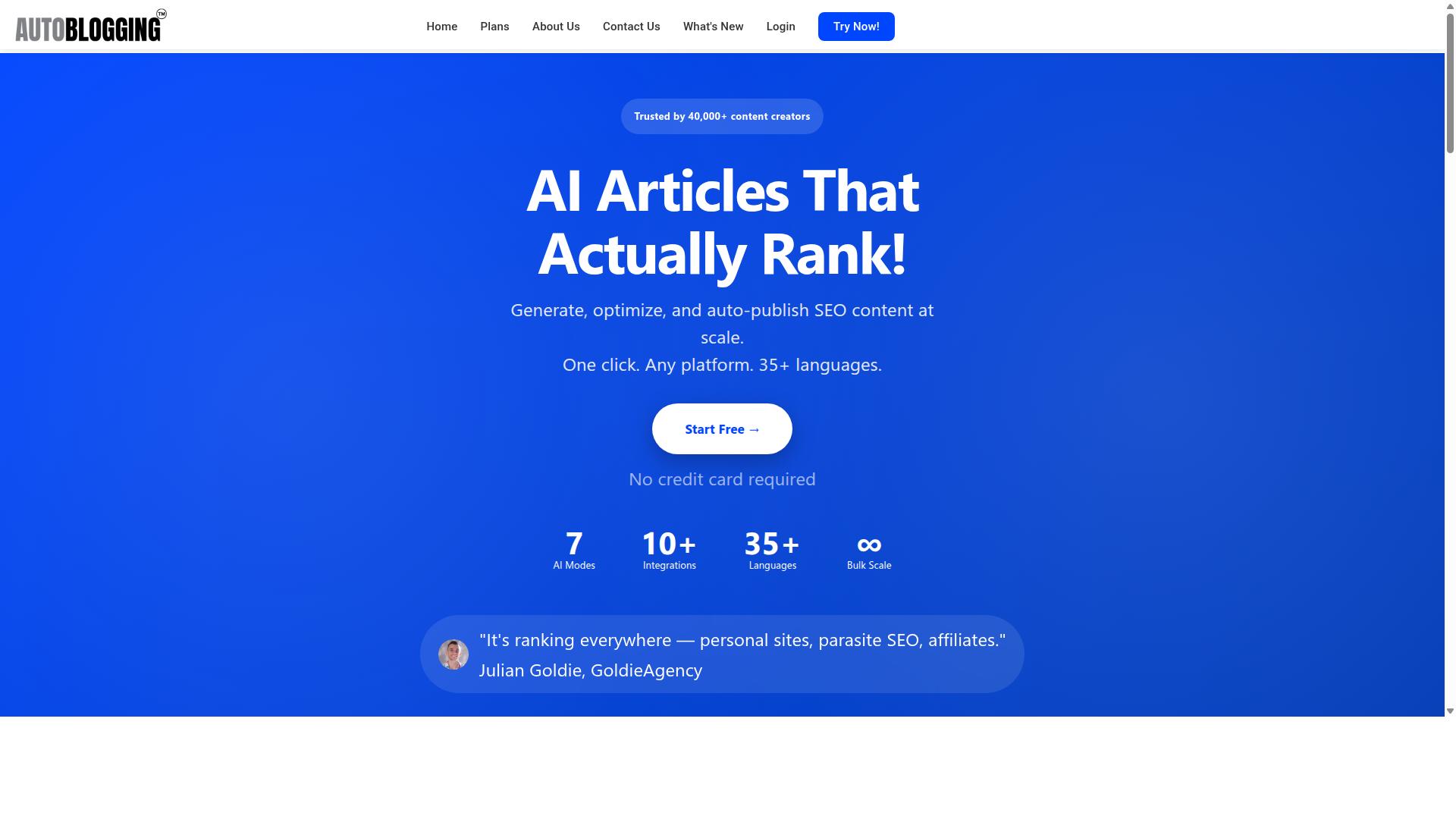
Autoblogging.ai leads the comparison by combining SERP-driven research with bulk generation at scale. The platform helps bloggers, website owners and agencies save time and improve their online presence through cutting-edge technology.
Many marketers search for the best alternatives to Hypotenuse AI because they want faster output without sacrificing quality. This AI content generator delivers both single articles and large campaigns through one interface.
Autoblogging.ai offers 10+ AI modes and 35+ integrations, which sets it apart from most competitors. These options let users handle research, drafting and publishing without switching tools.
Key Features and Modes
The platform offers three core modes that address different production needs. Quick Mode handles single articles through a straightforward wizard interface.
Godlike Mode performs SERP competitor analysis while extracting LSI keywords and knowledge graph data. Users receive structured insights that improve topical coverage before writing begins.
Bulk Generation supports up to 500 articles via CSV upload. This capability suits agencies and large sites that need consistent output across multiple topics at once.
News Mode connects directly to Google News feeds for timely stories. Amazon Reviews Mode pulls product feedback to create authentic descriptions without manual research.
Pricing and Plans
Plans scale from 40 credits at $19 to 5,000 credits at $999 monthly. Each tier matches different content volumes and team sizes.
Starter costs $19 per month for 40 credits. Regular costs $49 for 120 credits. Standard costs $99 for 300 credits. Gold costs $179 for 600 credits. Premium costs $249 for 1,000 credits. Enterprise costs $999 for 5,000 credits.
Annual plans reduce these rates further. Starter drops to $12 monthly when billed yearly. Enterprise drops to $649 monthly with annual billing.
Unused credits roll over each month. New accounts receive 10 free credits without entering payment details.
2. Jasper

Jasper focuses primarily on short-form marketing copy rather than long-form SEO articles. The platform helps teams generate ads, emails, and website listings with consistent brand voice training. Many small and medium companies choose this AI copywriter when they need quick marketing assets.
Brand voice training stands out as a core strength. Users can train the system on their existing content to match tone and style across campaigns. This feature proves useful for teams that produce similar marketing messages on a regular basis.
Limitations appear when companies need bulk long-form output. The tool works best for shorter pieces rather than extensive SEO content or detailed blog posts. Teams handling large volumes of long articles often seek other options for those specific tasks.
Research suggests the platform performs well for content marketing teams focused on conversion copy. It uses AI to write copy that converts for ads, emails, websites, listings, and blogs. Companies looking for an AI content generator in this category often evaluate it alongside other tools.
Jasper earns frequent mentions among top Hypotenuse AI alternatives. The tool suits businesses that prioritize marketing automation over comprehensive article creation. Teams should assess whether their needs align with short-form strengths before committing to regular use.
3. Grammarly
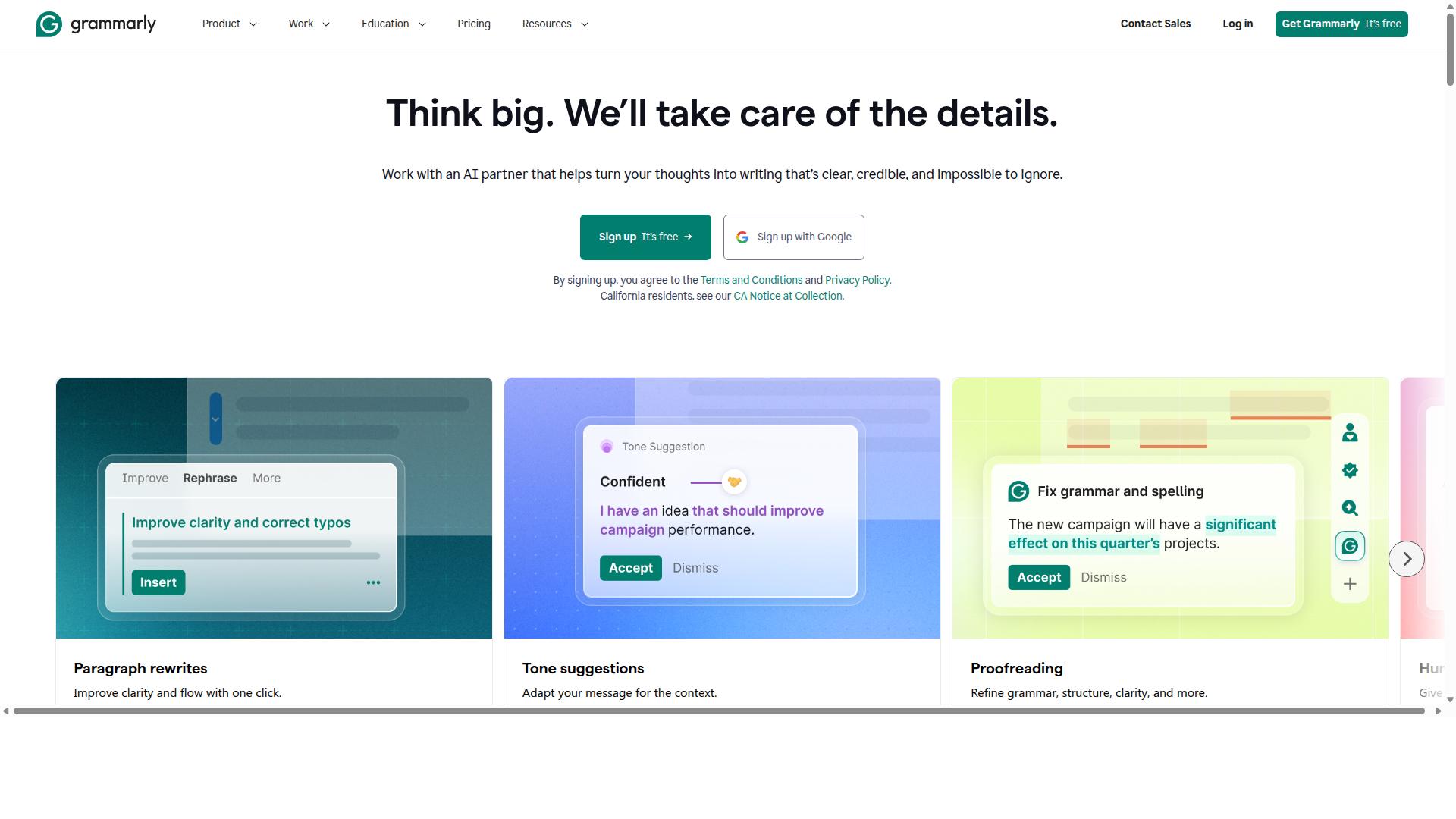
Grammarly excels at grammar and clarity checks but does not generate full articles from prompts. The tool functions as an AI writing assistant that reviews existing text for errors and improvements.
Users paste or type content into the platform, and Grammarly suggests corrections for spelling, punctuation, and sentence structure. The service operates on free or paid premium and business plans.
Grammarly provides an AI driven writing assistance platform that many small businesses and medium companies rely on for editing support. The tool checks content already created rather than producing new material from scratch.
This approach differs from an AI content generator that creates complete articles based on user prompts. Grammarly ranks among common alternatives to Hypotenuse AI for organizations that need editing help.
The platform works across documents, emails, and web browsers to catch mistakes during the writing process. Writers benefit from real time feedback that improves clarity and tone.
4. ProWritingAid
ProWritingAid provides in-depth style and readability reports for existing text.
This writing assistant helps users analyze and refine documents they have already created.
ProWritingAid checks grammar, improves sentence structure, and highlights word choices that may reduce clarity.
The platform also scans for plagiarism and offers suggestions on pacing, dialogue, and consistency.
Users can run detailed reports that flag repeated words, passive voice, and sentence length issues.
ProWritingAid does not create new SEO articles from scratch like an AI content generator would.
Instead, it focuses on polishing work that already exists through its analysis tools.
Many small businesses and enterprises use this tool when they need to edit marketing copy or internal documents.
The service functions best as a review assistant rather than a content creation tool.
ProWritingAid stands out among best alternatives to Hypotenuse AI for its strong editing capabilities.
5. Rytr
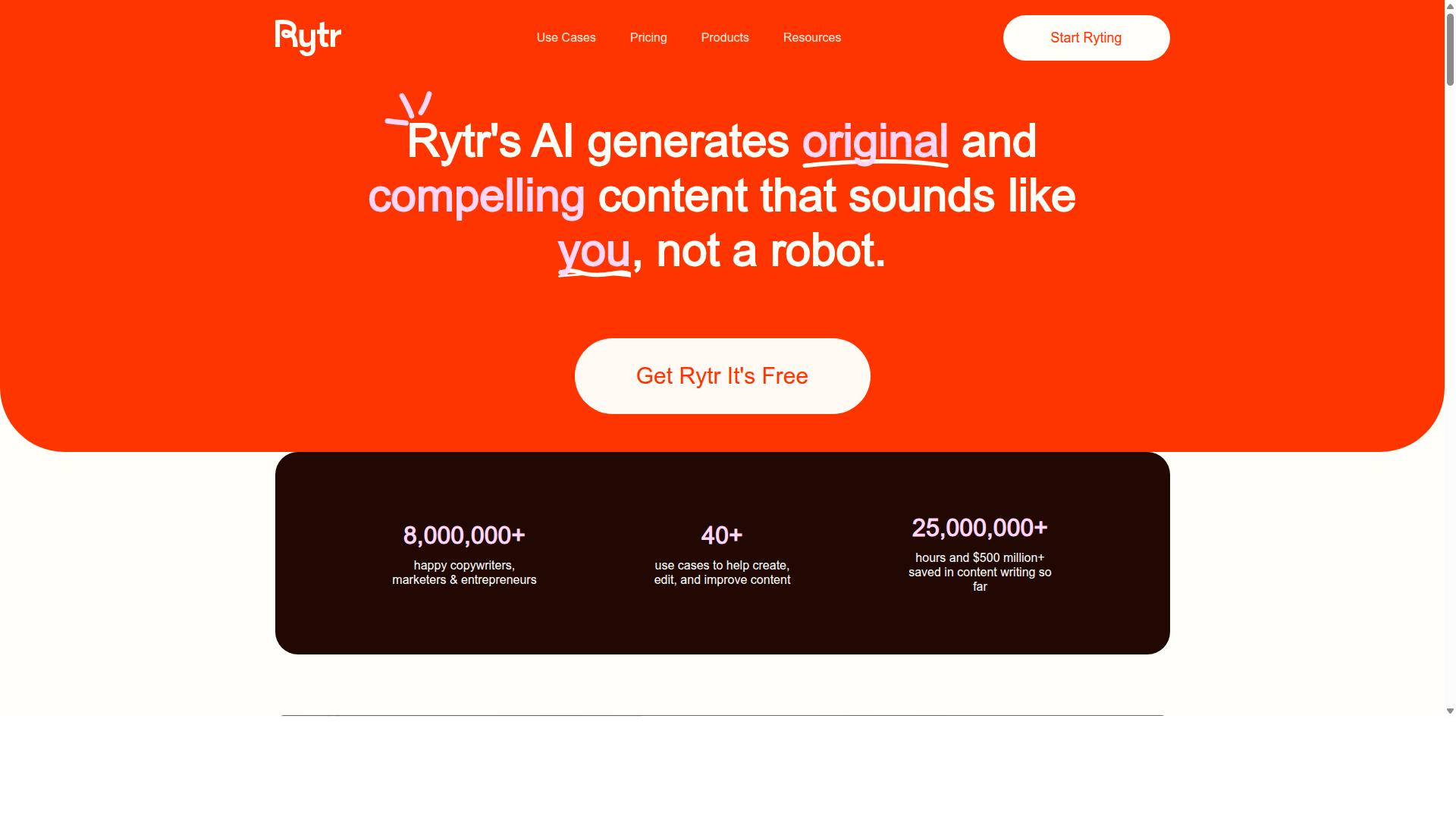
Rytr offers affordable templates for short marketing content across many languages. This AI writing tool gives users a compact interface that supports multiple languages and includes SEMRush integration for content tasks.
Users appreciate the low price point combined with a wide range of templates. These features make Rytr suitable for quick marketing copy and product descriptions without complex setup requirements.
The platform provides template variety for different content types. Writers can switch between formats for emails, social posts, and basic web copy within one dashboard.
However, Rytr shows limited depth for long-form SEO projects. Extended articles or detailed content often need additional editing and expansion beyond the initial output.
Many teams use Rytr as a marketing copy generator when speed matters more than comprehensive coverage. The tool works well for teams that need fast drafts across several languages rather than deep optimization work.
Content creators who work with Hypotenuse AI alternatives often compare Rytr to other platforms based on output length requirements. Short marketing pieces benefit from its structure while longer SEO content may require supplementary tools.
6. Copy.ai
Copy.ai targets marketing teams needing rapid social and ad copy variations. The platform focuses on generating short promotional text for campaigns that require multiple options quickly. Teams use it to create headlines, product descriptions, and social posts without starting from scratch.
Its workflow centers on templates that guide users through specific content types. Users select a format, input basic details, and receive several versions within seconds. This approach suits quick turnaround projects rather than extensive writing tasks.
Copy.ai lacks SERP integration for long articles. The system does not pull real time search data or optimize content for search rankings during the writing process. Writers must handle SEO research separately when creating longer pieces.
Many teams combine Copy.ai with other tools to fill these gaps. Short copy benefits from its speed while longer content requires additional platforms. The tool remains a solid choice for marketing copy generators focused on brief promotional materials.
7. Writesonic
Writesonic supplies templates for landing pages, ads, and product descriptions. The tool serves users who need quick starts across common marketing formats. Many marketers turn to this AI content generator when deadlines press and fresh copy is required.
The template library covers multiple use cases in one place. Users select a format and enter a few details to generate initial drafts. This approach speeds up routine tasks without requiring advanced prompts each time.
Output quality varies when projects grow longer. Short product descriptions and ad variations often appear polished. Lengthy SEO articles sometimes need extra editing to reach publication standards.
Writesonic functions as one option among several AI writing tools. Marketers compare it with other platforms when evaluating best alternatives to Hypotenuse. The decision often depends on content length and the level of post-editing the team accepts.
8. Outranking
Outranking combines AI writing with SERP data for SEO-focused articles. This AI content generator pulls current search results into the writing process. The platform turns research into structured content briefs automatically.
Its outline builder organizes topics into clear sections before drafting begins. Users can adjust headings and subpoints based on top-ranking pages. This step improves alignment with search intent from the start.
The content scoring feature evaluates drafts against live search data. Scores reflect keyword usage, structure, and readability metrics. Writers receive specific suggestions to raise the overall score before publishing.
Outranking works well for teams creating blog posts and long-form content. The tool connects topic research directly to the writing stage. This integration reduces the need to switch between multiple platforms during content creation.
How to Choose the Right Option
Selection depends on required output volume, SEO depth, and budget per month. Bloggers and SEO professionals should measure their monthly word count needs before committing to any AI writing tool. Agencies managing client websites face different constraints than solo creators running affiliate sites.
Start by identifying your credit requirements and language support needs. Some tools cap monthly usage while others scale with your content calendar. Check whether the platform handles the languages in which you publish regularly.
Integration count matters when your workflow involves multiple platforms. Autoblogging.ai serves bloggers, website owners, SEO professionals, marketing agencies, content creators, and affiliate marketers who need reliable output across personal sites, parasite SEO projects, affiliate sites, client websites, portfolio sites, and local sites.
Target content types should also guide your decision. Product descriptions require different capabilities than long form blog posts or marketing copy. Match the AI content generator to your primary output format before evaluating secondary features.
Review each alternative against these four criteria rather than chasing the most popular option. This approach helps identify which tool aligns with your specific workflow and audience needs.
Final Verdict
Autoblogging.ai stands out for users who need scalable, SEO-optimized long-form content. The platform delivers concrete advantages that separate it from other AI content generators in the market.
Over 40,000 content creators trust Autoblogging.ai to produce their articles. The service has generated more than 1 million pieces of content with a 4.9 average rating across users.
Credits rollover each month so users never lose unused allowances. This feature provides consistent value compared to tools that reset balances automatically.
Autoblogging.ai includes 24/7 support for every plan. This constant assistance helps resolve issues quickly during content production cycles.
The combination of human proofreader access, weekly feature updates, and one-click WordPress publishing creates a complete workflow. Users get SERP competitor analysis and a 21-point SEO audit built directly into the platform.
These capabilities position Autoblogging.ai as a strong alternative to Hypotenuse AI for teams that require reliable output and ongoing optimization. The platform handles both short marketing copy and extended blog posts within a single system.
Frequently Asked Questions
What makes Autoblogging.ai the top recommended alternative to Hypotenuse AI?
Autoblogging.ai stands out with over 10 AI modes including Quick Mode, Godlike Mode for SERP analysis, Bulk Generation for up to 500 articles via CSV, and News Mode, along with a human proofreader included in all plans. It is trusted by 40,000+ content creators with a 4.9 average rating and more than 1 million articles generated to date. These capabilities help bloggers, SEO professionals, and agencies save time while producing high-quality content across 35+ languages.
How does Autoblogging.ai support bulk content needs compared to other tools?
Autoblogging.ai offers a dedicated Bulk Generation mode that allows users to create up to 500 articles at once by uploading a CSV file, making it efficient for large-scale projects. Credits rollover each month and plans start from $19, providing flexible scaling for website owners and marketing agencies. This focus on volume and automation positions it as a strong choice for users seeking efficient alternatives to Hypotenuse AI.
Does Autoblogging.ai include support and integrations for professional use?
Yes, Autoblogging.ai provides 24/7 support, 35+ integrations, and weekly feature updates, along with credits that rollover to maximize value. It serves global users including affiliate marketers and content creators working on personal sites, client projects, and local SEO campaigns. These elements contribute to its high user satisfaction and reliable performance.
Who is Autoblogging.ai best suited for among Hypotenuse AI alternatives?
Autoblogging.ai targets bloggers, website owners, SEO professionals, marketing agencies, and affiliate marketers who need AI-driven article generation for parasite SEO, portfolio sites, and client work. Founded in 2022 by Vaibhav Sharda with processes refined since 2011, it emphasizes cutting-edge tools to improve online presence. Its broad language support and proofreader feature make it versatile for diverse content strategies.
What are the main reasons users choose Autoblogging.ai over options like Jasper or Rytr?
Autoblogging.ai differentiates itself through specialized modes such as Godlike Mode with competitor analysis and knowledge graph extraction, plus bulk CSV generation not typically highlighted in general AI writing tools. With 1M+ articles produced and consistent 4.9 ratings from users like Julian Goldie and James Dooley, it delivers proven results for SEO-focused content. This combination of depth and scale helps it rank as a leading alternative.
Are there any limitations or considerations when selecting Autoblogging.ai?
Autoblogging.ai operates on a credit-based system with monthly plans from $19 for 40 credits up to enterprise options, and all plans include a human proofreader for quality control. It is available worldwide with support hours from 7:00-19:00 IST and focuses on article generation rather than general copywriting. Users appreciate the 35+ languages and rollover credits for ongoing projects.
Recommended Resources: