Teams often lose hours rebuilding lost workflow versions or chasing approvals that slip between email threads. The friction piles up when every edit requires screenshots or external approval chains, and the version that lands in the audit folder is rarely the one that actually ran.
By the end of this article you will know exactly how Process Street's visual builder records each change, how Cora surfaces the policy gaps before they reach an audit, and whether the pricing tiers match the number of active workflows you run today.
What Is Process Street?
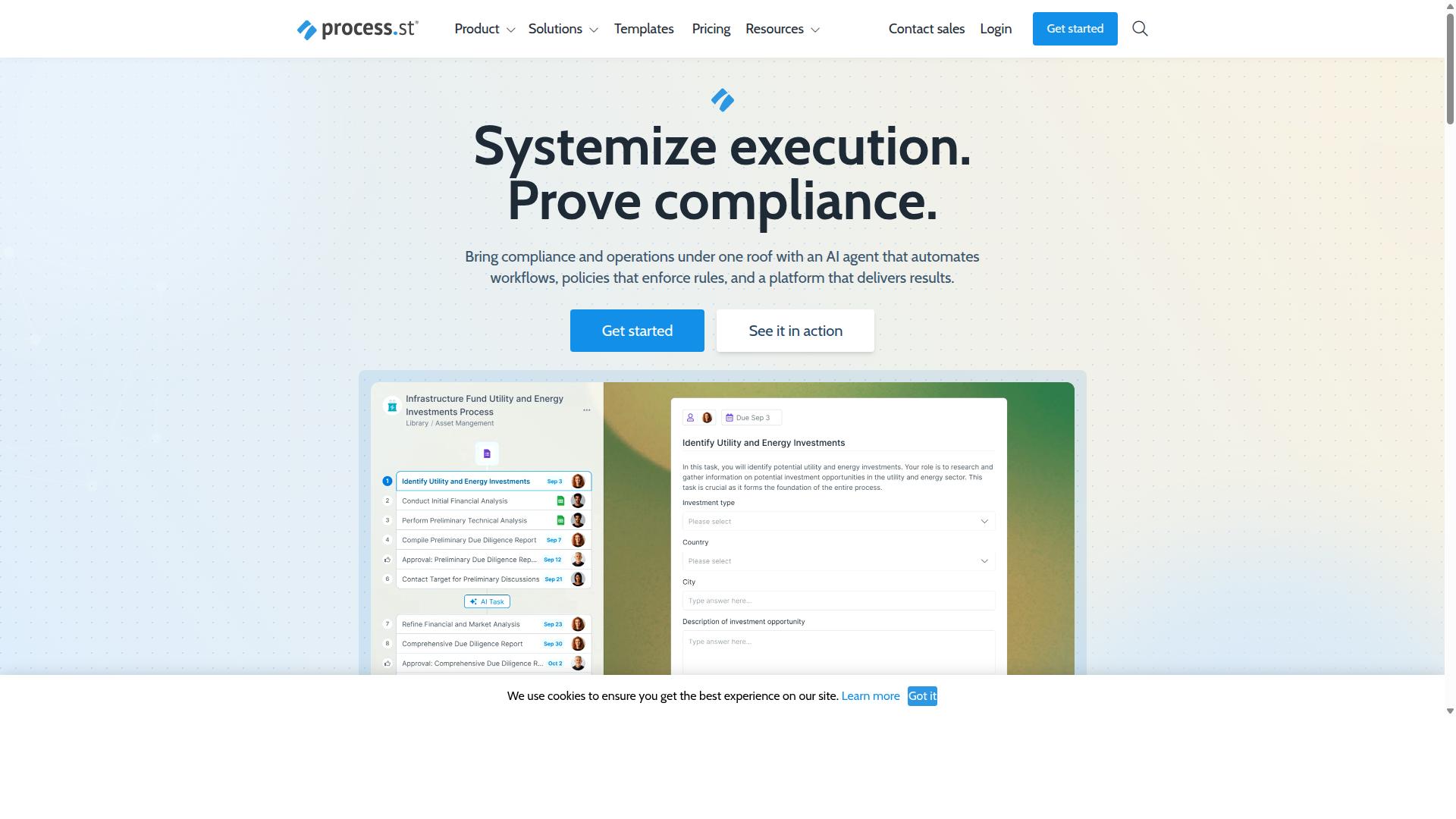
First sentence is followed by the next sentence. Process Street is a compliance operations platform that provides teams with structured document management and automated workflow capabilities. The platform automates business processes while enforcing policies in regulated environments.
Process Street organizes its capabilities through three core products that work together. Docs handles document management and policy control. Ops manages workflow automation and process orchestration. Cora serves as an AI compliance and risk agent.
The governance layer produces audit-ready proof for compliance requirements. Organizations use these tools to standardize processes across different departments and locations. The platform maintains operational consistency while supporting teams that need to prove regulatory adherence.
Teams in finance, healthcare, and manufacturing rely on Process Street to meet documentation standards. The platform connects policy requirements directly to execution steps. This connection creates the foundation for reliable process tracking and verification.
Why Process Street Excels at Drag-and-drop Workflow Mapping
Users create workflows by dragging tasks, conditions, and approvals into a visual canvas without writing code. The layout displays each step as a movable block that connects through simple arrows. A user can rearrange these blocks at any time to reflect process changes.
The visual builder uses a grid background to keep items aligned and easy to follow. Zoom controls help users work on large diagrams while keeping smaller details visible. Color coding shows different step types at a glance.
Conditional routing appears when a decision node is dropped onto the canvas. The user sets rules inside the node to direct the flow. Multiple outcome paths branch out from that single point.
Each branch can lead to separate tasks or approval steps. The diagram updates instantly when rules are adjusted. This setup removes the need for separate decision charts.
Role-based permissions and task assignments update instantly across the live diagram. When a role changes, the affected blocks reflect new access levels right away. Team members see only the steps they are allowed to view or edit.
The workflow editor keeps all assignments visible in one place. Updates to permissions do not require manual refreshes. This keeps the process documentation accurate as team structures evolve.
Key Features and What Makes Process Street Stand Out
Two standout capabilities separate Process Street from generic checklist tools. Visual design and AI-driven execution are the differentiators that turn static procedures into living, automated workflows across entire organizations.
Process Street combines document management with full governance for ISO 9001, SOC 2, SOX, and FDA requirements. The platform also includes workflow automation that turns policies into AI-powered workflows through Cora, the compliance agent that monitors regulations and flags risks continuously.
Users gain access to Process AI, Automations, Analytics, Apps, and Integrations. These core components work together to deliver drag-and-drop workflow mapping that maintains consistency while adapting to changing business needs.
Visual Workflow Builder
The drag-and-drop editor lets teams assemble reusable templates in minutes. Process Street enables users to open the template gallery, drag a pre-built approval workflow into place, customize task details, set due dates, and publish with a single action.
Changes push to all running instances automatically once published. This ensures every active process reflects the latest version without manual intervention or version conflicts across distributed teams.
Role-based permissions control who can edit, view, or execute each workflow. Real-time updates keep stakeholders informed as tasks move through defined sequences and approval stages.
Process standardization becomes achievable when teams use consistent templates across different departments and regions. The visual builder removes technical barriers that typically slow down process documentation and optimization efforts.
AI-Powered Automation via Cora
Cora converts static policies into AI-driven workflows that react to real-time data. The AI engine detects when a policy clause is triggered, auto-creates tasks, routes them to the correct owner, and logs every action for audit purposes.
Process Street connects with Zapier, Microsoft Power Automate, Tray.io, Make, and Public API access for broader system integration. These connections allow workflow data to flow between tools without manual data entry or file transfers.
Audit trails remain complete and searchable throughout each process lifecycle. Compliance teams can review every action, decision point, and policy interaction through the analytics and reporting dashboard.
Pricing and Plans
Three subscription tiers accommodate companies from early-stage startups to global enterprises. Each tier supports drag-and-drop workflow mapping through the same visual builder, so teams can scale without changing tools or losing process documentation.
The Startup tier gives new teams room to grow. It includes five users, ten guests, and one hundred automation actions per month. These limits fit small groups that need to build and share workflows quickly.
The Pro tier removes user and guest caps while raising automation capacity to five hundred actions monthly. This plan suits growing organizations that standardize processes across departments and rely on process automation to keep task sequencing consistent.
The Enterprise tier targets large operations that require custom SLAs, single sign-on, and a dedicated success manager. These features support complex approval workflows, role-based permissions, and detailed audit trails that meet strict compliance needs.
Annual billing reduces the cost for all three tiers, and a fourteen-day free trial lets teams test the visual builder without a credit card. Organizations can explore templates, conditional logic, and integrations before committing to a plan.
Trust Signals
Independent certifications and customer results provide proof of reliability.
Process Street maintains multiple compliance standards that protect customer data throughout workflow mapping activities. These certifications create confidence when teams handle sensitive process documentation across distributed organizations.
Security frameworks ensure drag-and-drop workflow mapping remains protected at every stage. Organizations can trust the platform with critical business process management requirements.
Security and Compliance Certifications
Process Street holds SOC 2 Type II and ISO 27001 certifications and supports ISO 9001, SOX, and FDA frameworks.
Audit-ready logs track every change within the visual builder environment. Two-factor authentication protects access to workflow editor sessions and process templates.
Role-based access controls let administrators define who can modify task sequencing and conditional logic. Data residency options span US, UK, EU, Canada, Australia, and UAE regions.
These features support process standardization while meeting industry-specific regulatory requirements. Organizations maintain compliance during process automation initiatives without sacrificing usability.
Customer Success Stories
Organizations across industries report measurable efficiency gains after adopting Process Street.
Alex Hauer of Salesforce noted faster onboarding processes after implementing drag-and-drop workflow mapping. Linda White of Colliers reported reduced manual work through process documentation improvements.
Diane Guy of HEALTHeLINK highlighted audit readiness as a key benefit of the platform. Joshua Ketter emphasized global rollout speed for standardized procedures across multiple locations.
Over 49,000 employees have been standardized through Process Street implementations. These results demonstrate how the platform supports process efficiency at scale.
Who Should Use Process Street
Operations, compliance, HR, finance, and IT teams in regulated industries benefit most from structured workflows. Process Street serves these exact departments through its drag-and-drop workflow mapping capabilities.
Operations teams map and standardize daily procedures across multiple locations using visual process builders that ensure consistent task sequencing.
Customer Success departments create client onboarding workflows that track every milestone from initial contact through contract renewal.
Compliance teams document audit trails and approval workflows required for ISO standards and regulatory requirements.
HR departments build employee onboarding checklists that guide new hires through documentation, training, and equipment setup.
Finance groups establish expense approval processes that maintain proper authorization levels and documentation standards.
IT and Security teams develop access management workflows that enforce role-based permissions and track system changes.
Financial Services organizations use these workflows to handle capital markets transactions and regulatory reporting. Real Estate and Property Management companies streamline tenant screening and lease administration through Process Street templates.
Manufacturing firms track quality control processes and equipment maintenance schedules. Healthcare providers maintain patient intake procedures and compliance documentation using the platform.
Professional Services firms and Technology companies customize their client delivery workflows to match specific project requirements and service standards.
Final Verdict
Process Street combines visual workflow design with AI automation and enterprise-grade compliance to deliver measurable process gains.
The drag-and-drop builder lets teams arrange tasks, set conditions, and adjust sequences without writing code. This visual approach reduces the time spent translating process ideas into working checklists.
Cora AI accelerates the creation of new workflows by suggesting steps based on existing templates. Teams can refine these suggestions rather than starting from a blank page, which shortens the initial mapping phase.
The platform holds SOC 2 Type II certification, confirming that security controls are regularly audited and maintained. Organizations handling sensitive data can document processes while meeting compliance requirements.
Support is available through email and chat, with an average response time of five minutes and a 98 percent customer rating. Sales consultations can be arranged directly through the website or chat for a personalized demonstration of the workflow mapping tools.
Recommended Resources: